Tag Archives: recreational mathematics

Numenko, Turning Square, and Toilet Paper

Welcome to this week’s Math Munch!

Have you ever played Scrabble or Bananagrams? Can you imagine versions of these games that would use numbers instead of letters?

Meet Tom Lennett, who imagined them and then made them!
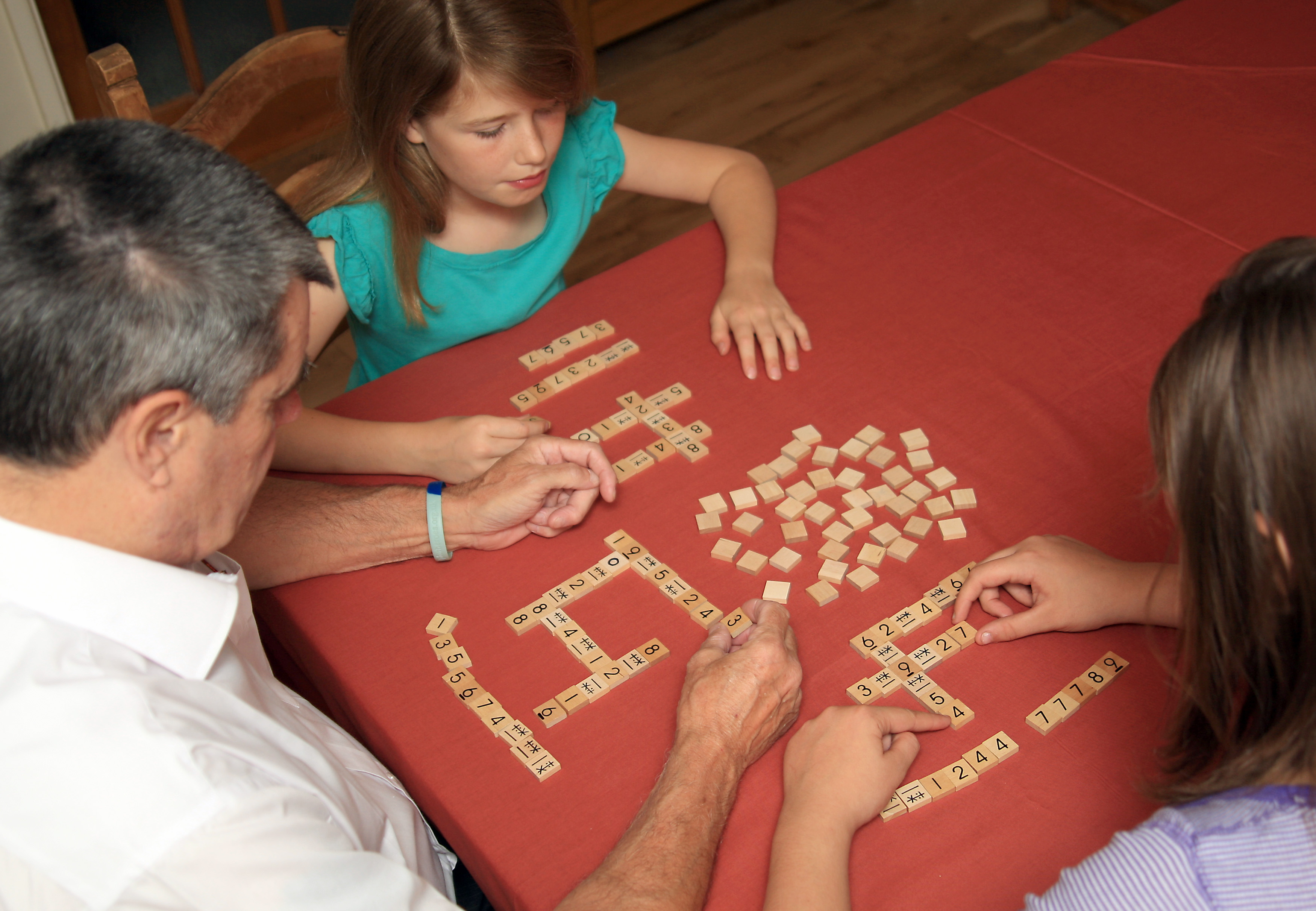
Tom playing Numenko with his grandkids.

Tom playing Numenko with his grandkids.

Numemko is a crossnumber game. Players build up number sentences, like 4×3+8=20, that cross each other like in a crossword puzzle. There is both a board game version of Numenko (like Scrabble) and a bag game version (like Banagrams). Tom invented the board game years ago to help his daughter get over her fear of math. He more recently invented the bag game for his grandkids because they wanted a game to play where they didn’t have to wait their turn!
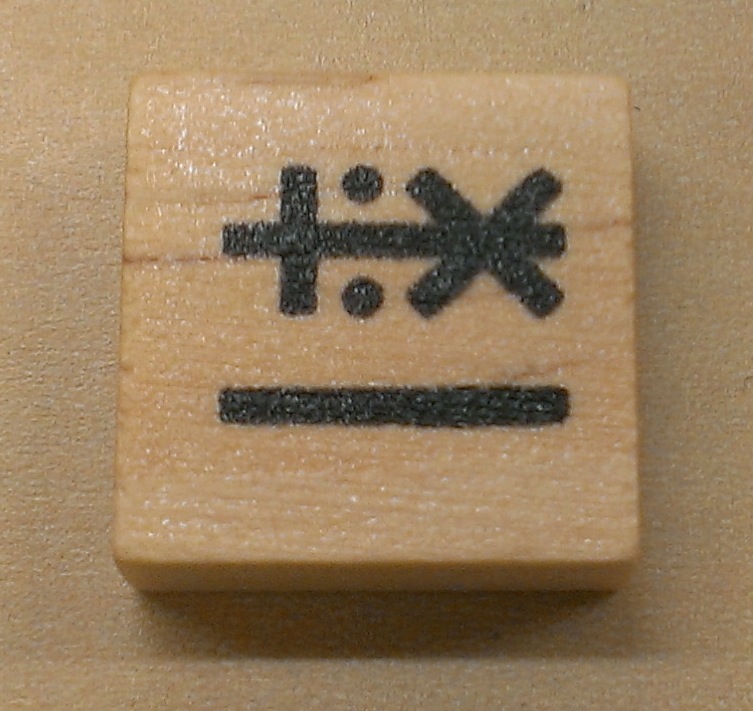
The Multichoice tile.

The Multichoice tile.

One important feature of Numenko is the Multichoice tile. Can you see how it can represent addition, subtraction, multiplication, division, or equality?

How would you like to have a Numenko set of your own? Well, guess what—Tom holds weekly Numenko puzzle competitions with prizes! You can see the current puzzle on this page, as well as the rules. Here’s the puzzle at the time of this post—the week of November 3, 2013.

Can you replace the Multichoice tiles to create a true number sentence?

Challenge: replace the Multichoice tiles to create a true number sentence.

I can assure you that it’s possible to win Tom’s competitions, because one of my students and I won Competition 3! I played my first games of Numenko today and really enjoyed them. I also tried making some Numenko puzzles of my own; see the sheet at the bottom of this post to see some of them.

Tom in 1972.

Tom in 1972.

In emailing with Tom I’ve found that he’s had a really interesting life. He grew up in Scotland and left school before he turned 15. He’s been a football-stitcher, a barber, a soldier, a distribution manager, a paintball site operator, a horticulturist, a property developer, and more. And, of course, also a game developer!

Do you have a question you’d like to ask Tom? Send it in through the form below, and we’ll try to include it in our upcoming Q&A!

leveledit

The level editor.

Say, do you like Bloxorz? I sure do—it’s one of my favorite games! So imagine my delight when I discovered that a fan of the game—who goes by the handle Jz Pan—created an extension of it where you can make your own levels. Awesome, right? It’s called Turning Square, and you can download it here.

(You’ll need to uncompress the file after downloading, then open TurningSquare.exe. This is a little more involved than what’s usual here on Math Munch, but I promise it’s worth it! Also, Turning Square has only been developed for PC. Sorry, Mac fans.)
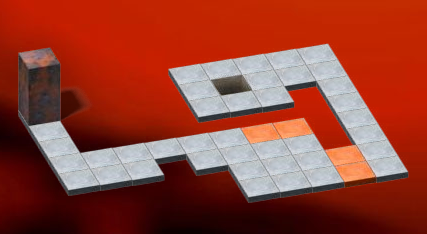
The level!

The level I made!

But wait, there’s more! Turning Square also introduces new elements to Bloxorz, like slippery ice and pyramids you can trip over. It has a random level generator that can challenge you with different levels of difficulty. Finally, Turning Square includes a level solver—it can determine whether a level that you create is possible or not and how many steps it takes to complete.

Jz Pan is from China and is now a graduate student at the Chinese Academy of Sciences, majoring in mathematics and studying number theory. Jz Pan made Turning Square in high school, back in 2008.

Jz Pan has agreed to answer some of your questions! Use the form below to send us some.

If you make a level in Turning Square that you really like, email us the .box file and we can share it with everyone through our new Readers’ Gallery! Here is my level from above, if you want to try it out.

Jz Pan has also worked on an even more ambitious extension of Bloxorz called Turning Polyhedron. The goal is the same, but like the game Dublox, the shape that you maneuver around is different. Turning Polyhderon features several different shapes. Check out this video of it being played with a u-polyhedron!

And if you think that’s wild, check out this video with multiple moving blocks!

Last up this week, have you ever heard that it’s impossible to fold a piece of paper in half more than eight times? Or maybe it’s seven…? Either way, it’s a “fact” that seems to be common knowledge, and it sure seems like it’s true when you try to fold up a standard sheet of paper—or even a jumbo sheet of paper. The stack sure gets thick quickly!
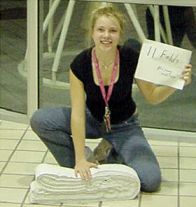
Britney Gallivan and her 11th fold.

Britney and her 11th fold.

Well, here’s a great story about a teenager who decided to debunk this “fact” with the help of some math and some VERY big rolls of toilet paper. Her name is Britney Gallivan. Back in 2001, when she was a junior in high school, Britney figured out a formula for how much paper she’d need in order to fold it in half twelve times. Then she got that amount of paper and actually did it!

Due to her work, Britney has a citation in MathWorld’s article on folding and even her own Wikipedia article. After high school, Britney went on to UC Berkeley where she majored in Environmental Science. I’m trying to get in touch with Britney for an interview—if you have a question for her, hold onto it, and I’ll keep you posted!

EDIT: I got in touch with Britney, and she’s going to do an interview!
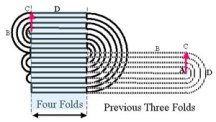
A diagram that illustrates how Britney derived her equation.

A diagram that illustrates how Britney derived her equation.

The best place to read more about Britney’s story in this article at pomonahistorical.org—the historical website of Britney’s hometown. Britney’s story shows that even when everyone else says that something’s impossible, that doesn’t mean you can’t be the one to do it. Awesome.

I hope you enjoy trying some Numenko puzzles, tinkering with Turning Square, and reading about Britney’s toilet paper adventure.

Bon appetit!

PS Want to see a video of some toilet-paper folding? Check out the very first “family math” video by Mike Lawler and his kids.

Reflection Sheet – Numenko, Turning Square, and Toilet Paper

Partial Cubes, Open Cubes, and Spidrons

Welcome to this week’s Math Munch!

Recently the videos that Paul and I made about the Yoshimoto Cube got shared around a bit on the web. That got me to thinking again about splitting cubes apart, because the Yoshimoto Cube is made up of two pieces that are each half of a cube.

A part of Wall Drawing #601 by Sol LeWitt

A part of Wall Drawing #601
by Sol LeWitt

A friend of mine once shared with me some drawings of cubes by the artist Sol LeWitt. The cubes were drawn as solid objects, but parts of them were cut away and removed. It was fun trying to figure out what fraction of a cube remained.

On the web, I found a beautiful image that Sol made called Wall Drawing #601. In the clipping of it to the left, I see 7/8 of a cube and 3/4 of a cube. Do you? You can view the whole of this piece by Sol on the website of the Greater Des Moines Public Art Foundation.

The Cube Vinco by Vaclav Obsivac.

The Cube Vinco by Vaclav Obsivac.

There are other kinds of objects that break a cube into pieces in this way, like this tricky puzzle by Vaclav Obsivac and this “shaved” Rubik’s cube modification. Maybe you’ll design a cube dissection of your own!

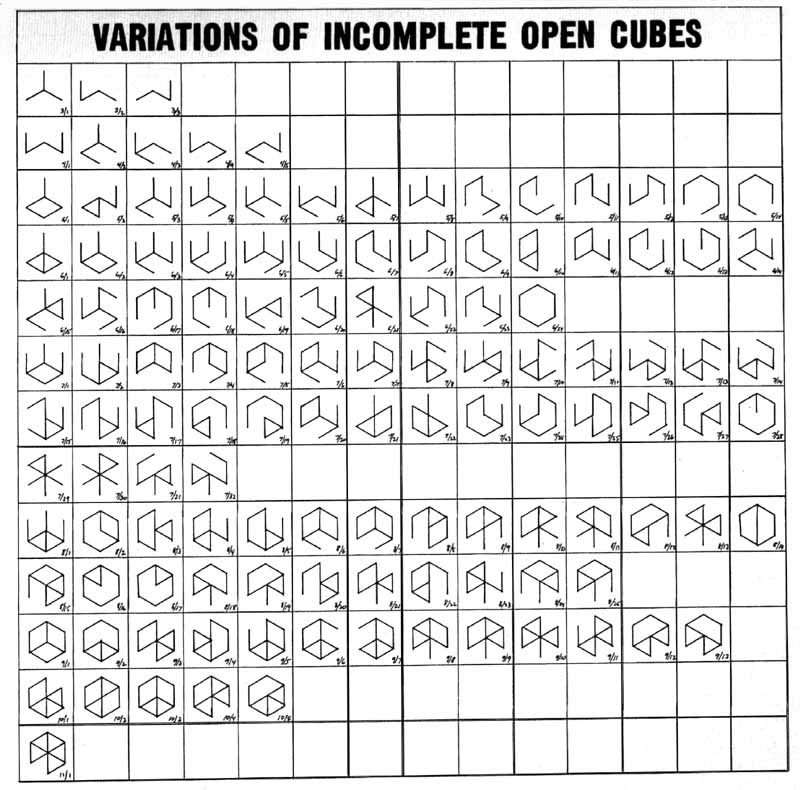
As I further researched Sol LeWitt’s art, I found that he had investigated partial cubes in other ways, too. My favorite of Sol’s tinkerings is the sculpture installation called “Variations of Incomplete Cubes“. You can check out this piece of artwork on the SFMOMA site, as well as in the video below.

In the video, a diagram appears that Sol made of all of the incomplete open cubes. He carefully listed out and arranged these pictures to make sure that he had found them all—a very mathematical task. It reminds me of the list of rectangle subdivisions I wrote about in this post.

sollewitt_variationsonincompleteopencubes_1974

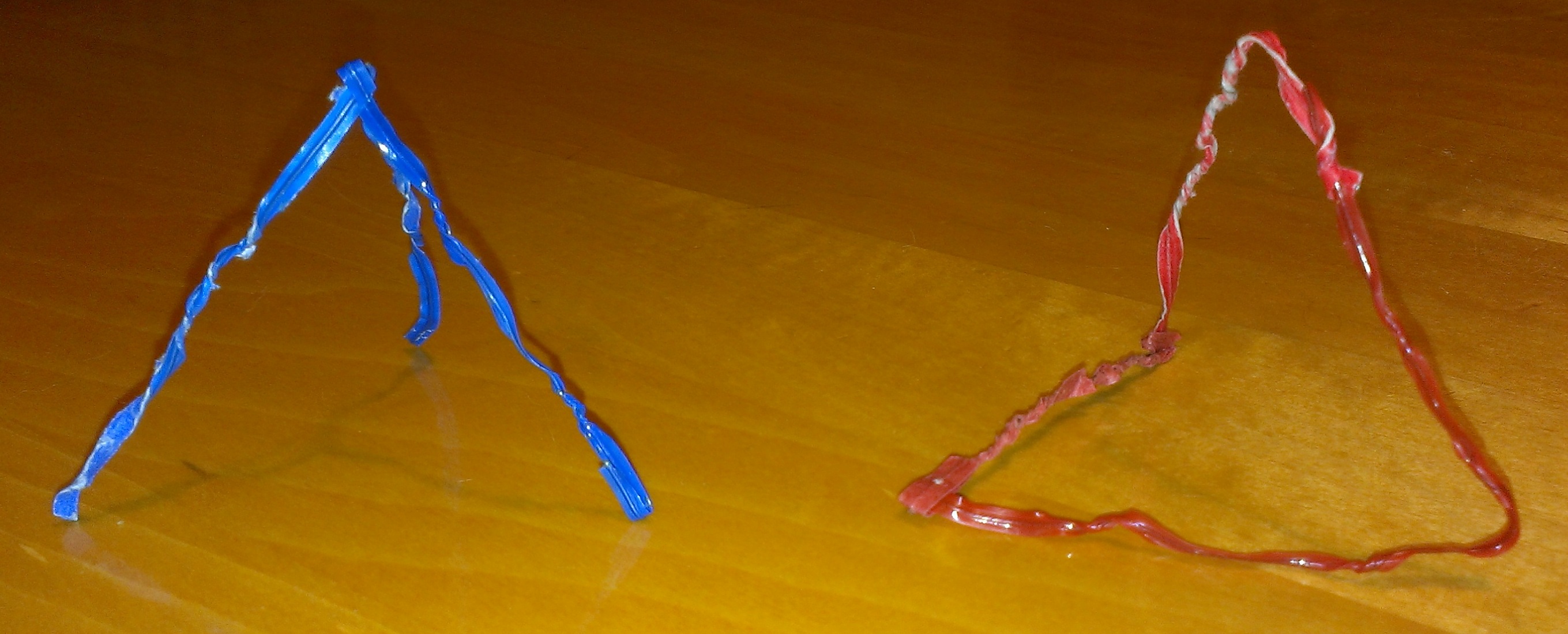
Sol’s diagram got me to thinking and making: what other shapes might have interesting “incomplete open” variations? I started working on tetrahedra. I think I might try to find and make them all. How about you?

Two open tetrahedra I made. Can you find some more?

Two open tetrahedra I made. Can you find some more?

Finally, as I browsed Google Images for “half cube”, one image in particular jumped out at me.

half-cube-newnweb

What are those?!?!

Dániel's original spidron from 1979

Dániel’s original spidron from 1979

These lovely rose-shaped objects are called spidrons—or more precisely, they appear to be half-cubes built out of fold-up spidrons. What are spidrons? I had never heard of them, but there’s one pictured to the right and they have their own Wikipedia article.

The first person who modeled a spidron was Dániel Erdély, a Hungarian designer and artist. Dániel started to work with spidrons as a part of a homework assignment from Ernő Rubik—that’s right, the man who invented the Rubik’s cube.

A cube with spidron faces.

A cube with spidron faces.

Two halves of an icosahedron.

Two halves of an icosahedron.

A hornflake.

A hornflake.

Here are two how-to videos that can help you to make a 3D spidron—the first step to making lovely shapes like those pictured above. The first video shows how to get set up with a template, and the second is brought to you by Dániel himself! Watching these folded spidrons spiral and spring is amazing. There’s more to see and read about spidrons in this Science News article and on Dániel’s website.

And how about a sphidron? Or a hornflake—perhaps a cousin to the flowsnake? So many cool shapes!

To my delight, I found that Dániel has created a video called Yoshimoto Spidronised—bringing my cube splitting adventure back around full circle. You’ll find it below. Bon appetit!

Reflection Sheet – Partial Cubes, Open Cubes, and Spidrons

TesselManiac, Zeno’s Paradox, and Platonic Realms

Welcome to this week’s Math Munch!

Before we begin, we’d like to thank all of you who have checked out the site in the past week. Since we’ve kicked off our share campaign, we’ve had so many new visitors and heard from many of them, too! Reading your feedback – whether a recommendation, some praise, a question, or just a brief, “Hello!” – brings us great joy and helps us to know that you all are out there.

Whether you’re a regular reader or visiting the site for the first time, we’d like to ask you for a little favor. If you see some math you like, share it with someone who you think would like it, too! Do you love the burst of excitement that you get from reading about a new mathematical idea, seeing an original piece of math artwork, or trying out a new game? Do you know someone who would love that, too? Then tell them about Math Munch – we’d love to spread the joy.

If you enjoy Math Munch, join in our “share campaign” this week.

You can read more about the share campaign here. There are lots of ways to participate, and you can let us know about your sharing through this form. We’d love to see the share total rise up to 1000 over the course of the next week.

Now for the post!

***

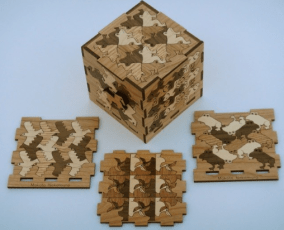
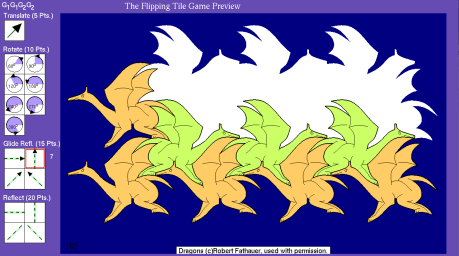
Lee boxThis beautiful tessellated wooden box was made by computer scientist and mathematical artist Kevin Lee. I met Kevin two weeks ago at the MOVES conference (which Justin and Paul have both written about already). Kevin teaches computer science at Normandale Community College in Minnesota. He makes woodcut tessellations (which won an award for the “Best Textile, Sculpture, or Other Medium” at the Joint Mathematics Meetings art exhibition this year!). He’s also used a combination of his knowledge of computer science and his love of Escher-type tessellations to make software that helps you create tessellations. His new software, TesselManiac!, is due out soon (watch this short movie Kevin made about it for the Bridges conference), but you can download an older version of the software here and play a preview version of The Flipping Tile Game.

tesselmaniac pictures

To play this game, you must fill in an outline of a tessellation with the piece given. You can use any of four symmetry motions – translation (or shift), rotation, reflection, or glide reflection (which reflects the tile and then translates it along a line parallel to the line of reflection). You get points for each correct tile placed (and lose points if you have to delete). Translations are the simplest, and only give you 5 points each. Reflections are the most difficult – you get 20 points for each one used!

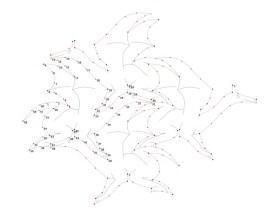
dot to dotWhile you’re downloading The Flipping Tile Game, try one of Kevin’s Dot-to-Dot puzzles. These are definitely not your typical dot-to-dot. Only the portion of the image corresponding to one tile in the tessellation is numbered. Once you figure out the shape of that single tile, you have to figure out how to number the rest of the puzzle!

Lucky for us, Kevin has agreed to answer some questions about his life and work as a math artist and computer scientist. Leave a question for Kevin here. (We’ll take questions for the next two weeks.)

tortoiseI’ve recently been thinking about a paradox that has puzzled mathematicians for centuries. Maybe you’ve heard of it. It’s one of the ancient Greek philosopher Zeno‘s paradoxes of motion, and it goes like this: Achilles (a really fast Greek hero) and a tortoise are going to run a race. Achilles agrees to give the tortoise a head-start, because the tortoise is so slow. Achilles then starts to run. But as Achilles catches up with the tortoise, the tortoise moves a little further. So the tortoise is still ahead. And as Achilles moves to catch up again, the tortoise moves even further! Sounds like Achilles will never catch up to the tortoise, let alone pass him… But that doesn’t make sense…

Will Achilles lose the race??? Check out this great video from Numberphile that explains both the paradox and the solution.

logo_PR_225_160While I was looking for information about this paradox, I stumbled across a great math resource site called Platonic Realms. The homepage of this site has a daily historical fact, mathematical quote, and puzzle.

The site hosts a math encyclopedia with explanations of all kinds of math terms and little biographies of famous mathematicians. You can also read “mini-texts” about different mathematical topics, such as this one about M. C. Escher (the inspiration behind the art at the beginning of this post!) or this one about coping with math anxiety.

I hope we here at Math Munch have given you something to tantalize your mathematical taste buds this week! If so, we’d love it if you would pass it along.

Thank you for reading, and bon appetit!

Rush hourP.S. – We’ve posted a new game, suggested to us by one of our readers! It’s an online version of Rush Hour. Check it out!