Tag Archives: video

Numenko, Turning Square, and Toilet Paper

Welcome to this week’s Math Munch!

Have you ever played Scrabble or Bananagrams? Can you imagine versions of these games that would use numbers instead of letters?

Meet Tom Lennett, who imagined them and then made them!
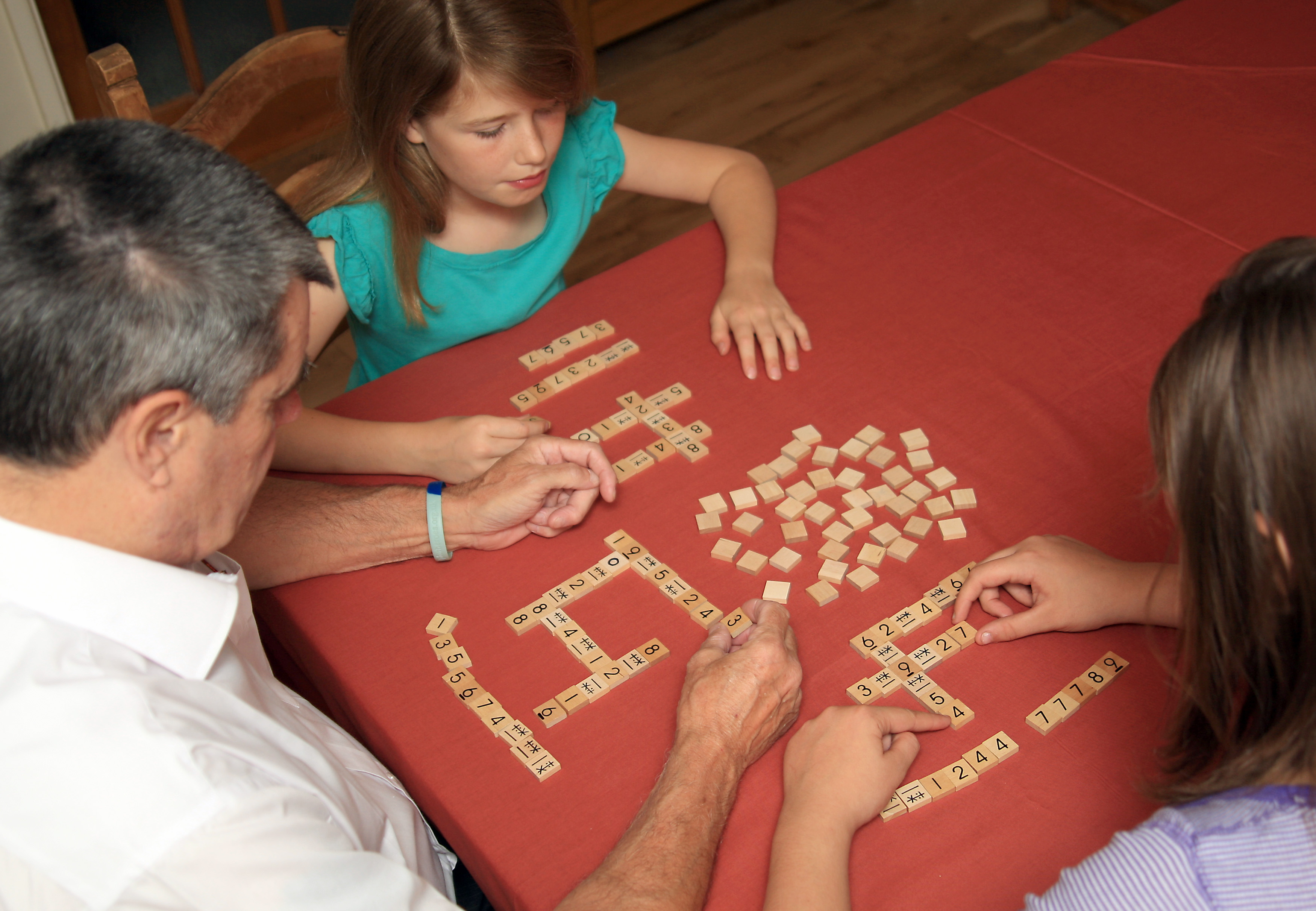
Tom playing Numenko with his grandkids.

Tom playing Numenko with his grandkids.

Numemko is a crossnumber game. Players build up number sentences, like 4×3+8=20, that cross each other like in a crossword puzzle. There is both a board game version of Numenko (like Scrabble) and a bag game version (like Banagrams). Tom invented the board game years ago to help his daughter get over her fear of math. He more recently invented the bag game for his grandkids because they wanted a game to play where they didn’t have to wait their turn!
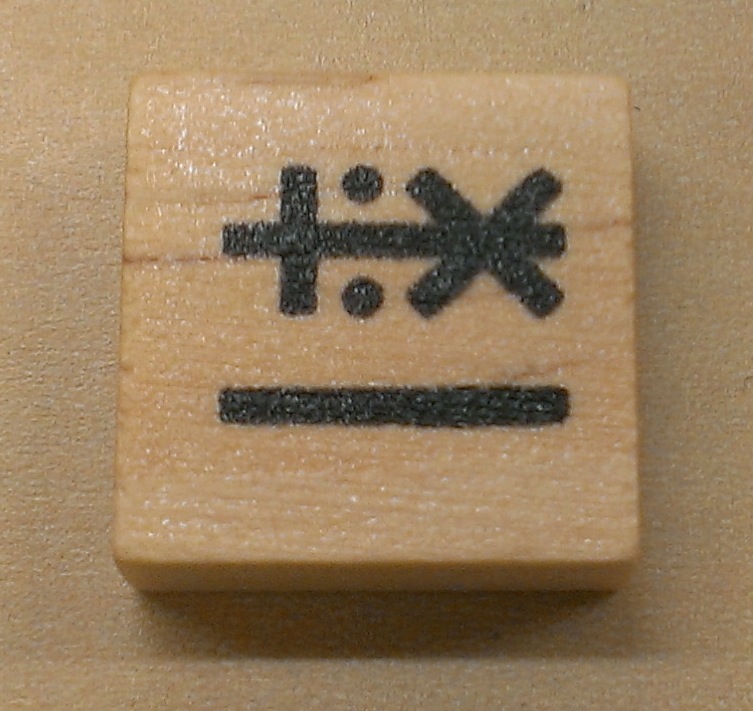
The Multichoice tile.

The Multichoice tile.

One important feature of Numenko is the Multichoice tile. Can you see how it can represent addition, subtraction, multiplication, division, or equality?

How would you like to have a Numenko set of your own? Well, guess what—Tom holds weekly Numenko puzzle competitions with prizes! You can see the current puzzle on this page, as well as the rules. Here’s the puzzle at the time of this post—the week of November 3, 2013.

Can you replace the Multichoice tiles to create a true number sentence?

Challenge: replace the Multichoice tiles to create a true number sentence.

I can assure you that it’s possible to win Tom’s competitions, because one of my students and I won Competition 3! I played my first games of Numenko today and really enjoyed them. I also tried making some Numenko puzzles of my own; see the sheet at the bottom of this post to see some of them.

Tom in 1972.

Tom in 1972.

In emailing with Tom I’ve found that he’s had a really interesting life. He grew up in Scotland and left school before he turned 15. He’s been a football-stitcher, a barber, a soldier, a distribution manager, a paintball site operator, a horticulturist, a property developer, and more. And, of course, also a game developer!

Do you have a question you’d like to ask Tom? Send it in through the form below, and we’ll try to include it in our upcoming Q&A!

leveledit

The level editor.

Say, do you like Bloxorz? I sure do—it’s one of my favorite games! So imagine my delight when I discovered that a fan of the game—who goes by the handle Jz Pan—created an extension of it where you can make your own levels. Awesome, right? It’s called Turning Square, and you can download it here.

(You’ll need to uncompress the file after downloading, then open TurningSquare.exe. This is a little more involved than what’s usual here on Math Munch, but I promise it’s worth it! Also, Turning Square has only been developed for PC. Sorry, Mac fans.)
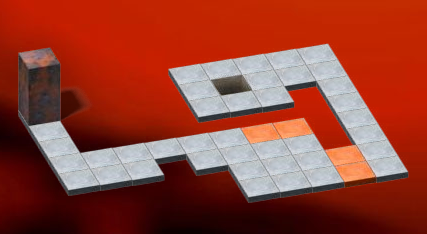
The level!

The level I made!

But wait, there’s more! Turning Square also introduces new elements to Bloxorz, like slippery ice and pyramids you can trip over. It has a random level generator that can challenge you with different levels of difficulty. Finally, Turning Square includes a level solver—it can determine whether a level that you create is possible or not and how many steps it takes to complete.

Jz Pan is from China and is now a graduate student at the Chinese Academy of Sciences, majoring in mathematics and studying number theory. Jz Pan made Turning Square in high school, back in 2008.

Jz Pan has agreed to answer some of your questions! Use the form below to send us some.

If you make a level in Turning Square that you really like, email us the .box file and we can share it with everyone through our new Readers’ Gallery! Here is my level from above, if you want to try it out.

Jz Pan has also worked on an even more ambitious extension of Bloxorz called Turning Polyhedron. The goal is the same, but like the game Dublox, the shape that you maneuver around is different. Turning Polyhderon features several different shapes. Check out this video of it being played with a u-polyhedron!

And if you think that’s wild, check out this video with multiple moving blocks!

Last up this week, have you ever heard that it’s impossible to fold a piece of paper in half more than eight times? Or maybe it’s seven…? Either way, it’s a “fact” that seems to be common knowledge, and it sure seems like it’s true when you try to fold up a standard sheet of paper—or even a jumbo sheet of paper. The stack sure gets thick quickly!
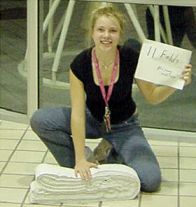
Britney Gallivan and her 11th fold.

Britney and her 11th fold.

Well, here’s a great story about a teenager who decided to debunk this “fact” with the help of some math and some VERY big rolls of toilet paper. Her name is Britney Gallivan. Back in 2001, when she was a junior in high school, Britney figured out a formula for how much paper she’d need in order to fold it in half twelve times. Then she got that amount of paper and actually did it!

Due to her work, Britney has a citation in MathWorld’s article on folding and even her own Wikipedia article. After high school, Britney went on to UC Berkeley where she majored in Environmental Science. I’m trying to get in touch with Britney for an interview—if you have a question for her, hold onto it, and I’ll keep you posted!

EDIT: I got in touch with Britney, and she’s going to do an interview!
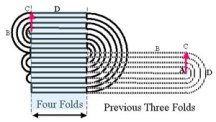
A diagram that illustrates how Britney derived her equation.

A diagram that illustrates how Britney derived her equation.

The best place to read more about Britney’s story in this article at pomonahistorical.org—the historical website of Britney’s hometown. Britney’s story shows that even when everyone else says that something’s impossible, that doesn’t mean you can’t be the one to do it. Awesome.

I hope you enjoy trying some Numenko puzzles, tinkering with Turning Square, and reading about Britney’s toilet paper adventure.

Bon appetit!

PS Want to see a video of some toilet-paper folding? Check out the very first “family math” video by Mike Lawler and his kids.

Reflection Sheet – Numenko, Turning Square, and Toilet Paper

Digital Art, Mastermind, and Pythagoras

Welcome to this week’s Math Munch… on (approximately) Math Munch’s second birthday! Hooray!

Check out this video of mathematical art made by artist Nathan Selikoff:

Cool, right? This piece is called “Beautiful Chaos.” The curves on the screen are made from equations (if you’ve ever graphed a line or a parabola you’ll know what I mean). As the viewer waves her hands around, the equations change– and as the equations change, so do the curves! The result is something that might remind you of the images your computer makes when you play music on it or maybe of something you’d make using a spirograph. All in all, a beautiful and interactive piece of mathematical art.

nathanNathan lives and works as a mathematical artist in Orlando, Florida. As he writes on his website, Nathan uses computer code along with other materials to make art that plays with the mathematical ideas of space, motion, and interaction between objects. To see more of how Nathan does this, check out his giant, interactive marionette or this song that explores the first, second, third, and fourth dimensions:

My school is really lucky to be hosting Nathan this week! We didn’t want any of you, dear readers, to miss out on the excitement, though– so Nathan has kindly agreed to answer your interview questions! Got a question for Nathan? Write it in the box below. He’ll answer seven of your best questions in two weeks!

565px-MastermindNext up, who doesn’t love to play Mastermind? It’s a great combination of logic, patterns, and trickery… but I just hate having to use all those tiny pegs. Well, guess what? You can play it online— no pegs (or opponent) necessary!

As I was playing Mastermind, I started wondering about strategy. What’s the best first guess to make? If I were as smart as a computer, is there a number of guesses in which I could guess any Mastermind code? (This kind of question reminds me of God’s Number and the Rubik’s cube…)

Well, it turns out there is a God’s Number for Mastermind – and that number is five. Just five. If you played perfectly and followed the strategy demonstrated by recreational mathematician Toby Nelson on his website, you could guess ANY Mastermind code in five guesses or less. Toby shares many more interesting questions about Mastermind on his website— I suggest you check it out.

What ARE those irrational numbers, so weird that they get their own bubble??

What ARE those irrational numbers, so weird that they get their own bubble??

Finally, sometime in your mathematical past you may have heard of irrational numbers. These are numbers like the square-root of 2 or pi or e that can’t be written as a fraction– or so people claim. When you start thinking about this claim, however, it may seem strange. There are A LOT of fractions– and none of them equal the square-root of 2? Really? What kind of number is that? It seems like only an irrational person would believe that, at least without proof.

Vi Hart to the rescue! Irrational numbers were encountered long, long ago by the ancient Greek mathematician (and cult leader) Pythagoras– and he didn’t like them much. In this great video, Vi tells all about Pythagoras and the controversial discovery of numbers that aren’t fractions.

If you didn’t follow her explanation of why the square-root of 2 is irrational on your first watch, don’t worry– it’s a complicated idea that’s worth a second (or third or fourth) run-through.

Thanks for a great two years of Math Munch! Bon appetit!

Tsoro Yematatu, Fano’s Plane, and GIFs

Welcome to this week’s Math Munch!

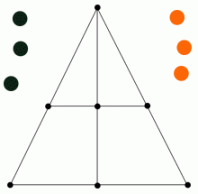
Board and pieces for tsoro yematatu.

Here’s a little game with a big name: tsoro yematatu. If you enjoyed Paul’s recent post about tic-tac-toe, I think you’ll like tsoro yematatu a lot.

I ran across this game on a website called Behind the Glass. The site is run by the Cincinnati Art Museum. (What is it with me and art museums lately?) The museum uses Behind the Glass to curate many pieces of African art and culture, including four mathematical games that are played in Africa.

The simplest of these is tsoro yematatu. It has its origin in Zimbabwe. Like tic-tac-toe, the goal is to get three of your pieces in a row, but the board is “pinched” and you can move your pieces. Here’s an applet where you can play a modified version of the game against a computer opponent. While the game still feels similar to tic-tac-toe, there are brand-new elements of strategy.

Tsoro yematatu reminds me of one that I played as a kid called Nine Men’s Morris. I learned about it and many other games—including go—from a delightful book called The Book of Classic Board Games. Kat Mangione—a teacher, mom, and game-lover who lives in Tennessee—has compiled a wonderful collection of in-a-row games. And wouldn’t you know, she includes Nine Men’s Morris, tsoro yematatu, tic-tac-toe, and dara—another of the African games from Behind the Glass.

The Fano plane.

The Fano plane.

The board for tsoro yematatu also reminds me of the Fano plane. This mathematical object is very symmetric—even more than meets the eye. Notice that each point is on three lines and that each line passes through three points. The Fano plane is one of many projective planes—mathematical objects that are “pinched” in the sense that they have vanishing points. They are close cousins of perspective drawings, which you can check out in these videos.

Can you invent a game that can be played on the Fano plane?

Closely related to the Fano plane is an object called the Klein quartic. They have the same symmetries—168 of them. Felix Klein discovered not only the Klein quartic and the famous Klein bottle, but also the gorgeous Kleinian groups and the Beltrami-Klein model. He’s one of my biggest mathematical heroes.

The Klein quartic.

The Klein quartic.

This article about the Klein quartic by mathematician John Baez contains some wonderful images. The math gets plenty tough as the article goes on, but in a thoughtfully-written article there is something for everyone. One good way to learn about new mathematics is to read as far as you can into a piece of writing and then to do a little research on the part where you get stuck.

If you’ve enjoyed the animation of the Klein quartic, then I bet my last find this week will be up your alley, too. It’s a Tumblr by David Whyte and Brian Fitzpatrick called Bees & Bombs. David and Brian create some fantastic GIFs that can expand your mathematical imagination.

This one is called Pass ‘Em On. I find it entrancing—there’s so much to see. You can follow individual dots, or hexagons, or triangles. What do you see?

tumblr_mqgfq5XLjI1r2geqjo1_500

This one is called Blue Tiles. It makes me wonder what kind of game could be played on a shape-shifting checkerboard. It also reminds me of parquet deformations.

tumblr_mnor4buGS01r2geqjo1_500

A few of my other favorites are Spacedots and Dancing Squares. Some of David and Brian’s animations are interactive, like Pointers. They have even made some GIFs that are inspired by Tilman Zitzmann’s work over at Geometry Daily (previously).

I hope you enjoy checking out all of these new variations on some familiar mathematical objects. Bon appetit!

Reflection Sheet – Tsoro Yematatu, Fano’s Plane, and GIFs