Category Archives: Math Munch

Demonstrations, a Number Tree, and Brainfilling Curves

Welcome to this week’s Math Munch!

Maybe you’re headed back to school this week. (We are!) Or maybe you’ve been back for a few weeks now. Or maybe you’ve been out of school for years. No matter which one it is, we hope that this new school year will bring many new mathematical delights your way!

A website that’s worth returning to again and again is the Wolfram Demonstrations Project (WDP). Since it was founded in 2007, users of the software package Mathematica have been uploading “demonstrations” to this website—amazing illuminations of some of the gems of mathematics and the sciences.

Each demonstration is an interactive applet. Some are very simple, like one that will factor any number up to 10000 for you. Others are complex, like this one that “plots orbits of the Hopalong map.”

Some demonstrations are great for visualizing facts about math, like these:
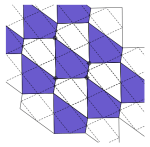
Any Quadrilateral Can Tile

A Proof of Euler’s Formula

Cube Net or Not?

There’s also a whole category of demonstrations that can be used as MArTH—mathematical art—tools, including these:

Rotate and Fold Back

Polygons Arranged in a Circle

Turtle Fractals

With over 8000 demonstrations to explore and new ones being added all the time, you can see why the Wolfram Demonstrations Project is worth returning to again and again!
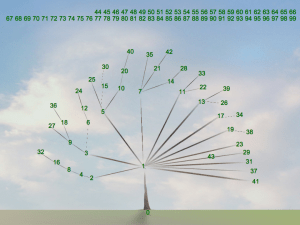
Jeffrey Ventrella’s Number Tree

Next up, check out this number tree. It was created by Jeffrey Ventrella, an innovator, artist, and computer programmer who lives in San Francisco. His number tree arranges the numbers from 1 to 100 according to their largest proper factors. For instance, the factors of 18 are 18, 9, 6, 3, 2, and 1. Once we toss out 18 itself as being “improper”—a.k.a. “uninteresting”—the largest factor of 18 is 9. This in turn has as its largest factor 3, and 3 goes down to 1. Chains of factors like this one make up Jeffrey’s tree. It has a wonderful accumulative feeling to it—it’s great to watch how patterns and complexity build up over time.

(On this theme, WDP also has a demonstrations about trees and about prime factorization graphs.)

Cloctal: “a fractal design that visualizes the passage of time”

There’s lots more math to explore on Jeffrey’s website. His piece Cloctal—a fractal clock—is one of my favorites. What I’d like to feature here, though, is the diverse and intricate work Jeffrey has done with plane-filling and space-filling curves.  You can find many examples at fractalcurves.com, Jeffrey’s website that’s chock full of great links.

Jeffrey recently completed a book called Brainfilling Curves. It’s “a visual math expedition, lead by a lifelong fractal explorer.” According to the description, the book picks up where Mandelbrot left off and develops an intuitive scheme for understanding an “infinite universe of fractal beauty.”
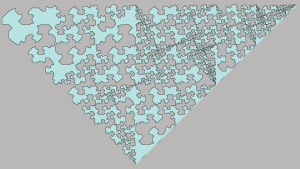
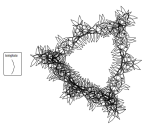
An example of a “brainfilling curve” from Jeffrey’s “root8” family

The title comes from the idea that nature uses space-filling curves quite often, to pack intestines into your gut or lots and lots of tissue into the brain you’re using to read this right now! Hopefully you’re finding all of this math quite brainfilling as well.

(And just one more example of why WDP is worth revisiting: here’s a demonstration that depicts the space-filling Hilbert and Moore curves. So much good stuff!)

Finally, here’s a video that Jeffrey made about brainfilling curves. You can find more on his YouTube channel.

Bon appetit!

Visualizations, Inspirations, and the Super Ultimate Graphing Challenge

Welcome to this week’s Math Munch!

Jason Davies

Meet Jason Davies, a freelance mathematician living in the UK. Growing up in Wales (one of the 4 countries of the United Kingdom) his classes were taught in Welsh. This makes Jason one of only about 611,000 people that speak the language, only 21.7% of the population of Wales! Imagine if only 1/5 of France spoke French!! These statistics are from a 2004 study, so the numbers may have changed a bit, but they still say something interesting don’t they?

Prime Seive

Jason is all about what numbers and pictures can tell us.  Since graduating from Cambridge, he’s been doing all sorts of data visualization and computer science on his own for various companies and IT firms. I originally found Jason through a link to his Prime Seive visualization, but take a look at his gallery and you’re bound to find something beautiful, interesting, interactive, and cool. I’ve linked to some of my favorites below.

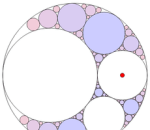
Interactive Apollonian Gasket

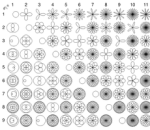
Rhodonea Curves

Set Partitions

I asked Jason a few questions about his interest in data visualization and math in general. Here’s a tasty little excerpt:

MM: What’s the most important trait for a mathematician to have? Is there one?

JD: Persistance is always useful in maths! I think the stereotype is to be analytical and logical, but in fact there are many other traits that are highly important, for instance communication skills. Mathematics is passed on from person to person, after all, so being able to communicate ideas effectively is dynamite.

MM: Do you have a message you’d like to give to young mathematicians?

JD: The world needs you!

Read the rest in our Q&A with Jason Davies, and you can see all of our interviews on the Q&A page we’ve just created.

Up next, a beautiful and inspiring video from Spain. The video is actually called Insprations, and it comes to us from Etérea Studios, the online home of animator Cristóbal Vila. In the intro he says, “I looked into that enormous and inexhaustible source of inspiration that is Escher and tried to imagine how it could be his workplace, what things would surround an artist like him, so deeply interested in science in general and mathematics in particular.”

I’d die to have an office like this!

It gets better.  Cristóbal added a page explaining all of the wonderful maths in the video. Click to read about Platonic solids, tilings, tangrams, and various works of art by M.C. Escher.

Finally, a nifty new game that explores the relationship between graphs and different kinds of motion. Super Ultimate Graphing Challenge is a game developed by Physics teacher Matthew Blackman to help his students understand the physics and mathematics of motion. You might not understand it all when you start, but keep playing and see what you can make of it. If you need a bit of help or have something to say, post it in our comments, and we’ll happily reply.

Bon appetit!

Newroz, a Math Factory, and Flexagons

Welcome to this week’s Math Munch!

You’ve probably seen Venn diagrams before. They’re a great way of picturing the relationships among different sets of objects.

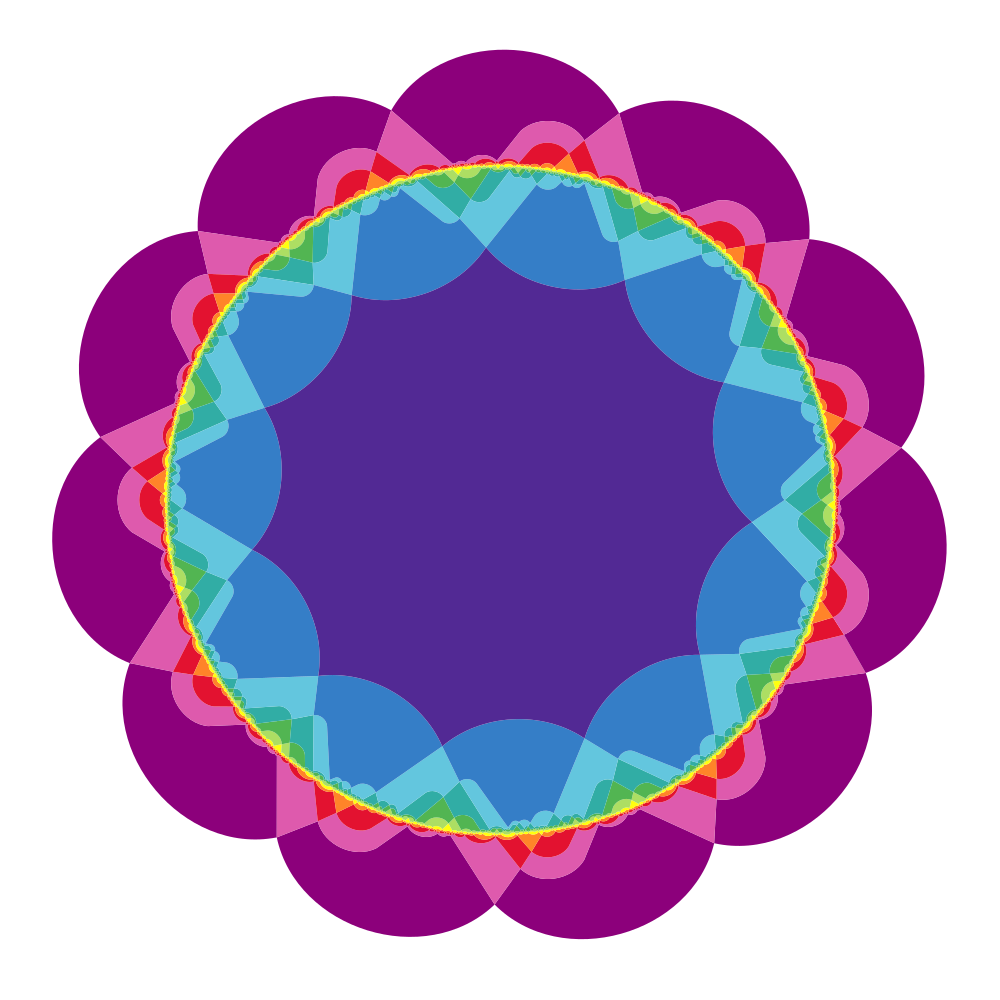
But I bet you’ve never seen a Venn diagram like this one!

Frank Ruskey

That’s because its discovery was announced only a few weeks ago by Frank Ruskey and Khalegh Mamakani of the University of Victoria in Canada. The Venn diagrams at the top of the post are each made of two circles that carve out three regions—four if you include the outside. Frank and Khalegh’s new diagram is made of eleven curves, all identical and symmetrically arranged. In addition—and this is the new wrinkle—the curves only cross in pairs, not three or more at a time. All together their diagram contains 2047 individual regions—or 2048 (that’s 2^11) if you count the outside.

Frank and Khalegh named this Venn diagram “Newroz”, from the Kurdish word for “new day” or “new sun”. Khalegh was born in Iran and taught at the University of Kurdistan before moving to Canada to pursue his Ph.D. under Frank’s direction.

Khalegh Mamakani

“Newroz” to those who speak English sounds like “new rose”, and the diagram does have a nice floral look, don’t you think?

When I asked Frank what it was like to discover Newroz, he said, “It was quite exciting when Khalegh told me that he had found Newroz. Other researchers, some of my grad students and I had previously looked for it, and I had even spent some time trying to prove that it didn’t exist!”

Khalegh concurred. “It was quite exciting. When I first ran the program and got the first result in less than a second I didn’t believe it. I checked it many times to make sure that there was no mistake.”

You can click these links to read more of my interviews with Frank and Khalegh.

I enjoyed reading about the discovery of Newroz in these articles at New Scientist and Physics Central. And check out this gallery of images that build up to Newroz’s discovery. Finally, Frank and Khalegh’s original paper—with its wonderful diagrams and descriptions—can be found here.

A single closed curve—or “petal”— of Newroz. Eleven of these make up the complete diagram.

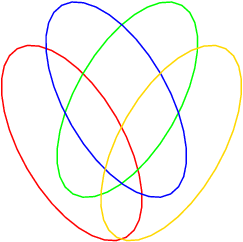
A Venn diagram made of four identical ellipses. It was discovered by John Venn himself!

For even more wonderful images and facts about Venn diagrams, a whole world awaits you at Frank’s Survey of Venn Diagrams.

On Frank’s website you can also find his Amazing Mathematical Object Factory! Frank has created applets that will build combinatorial objects to your specifications. “Combinatorial” here means that there are some discrete pieces that are combined in interesting ways. Want an example of a 5×5 magic square? Done! Want to pose your own pentomino puzzle and see a solution to it? No problem! Check out the rubber ducky it helped me to make!

A pentomino rubber ducky!

Finally, Frank mentioned that one of his early mathematical experiences was building hexaflexagons with his father. This led me to browse around for information about these fun objects, and to re-discover the work of Linda van Breemen. Here’s a flexagon video that she made.

And here’s Linda’s page with instructions for how to make one. Online, Linda calls herself dutchpapergirl and has both a website and a YouTube channel. Both are chock-full of intricate and fabulous creations made of paper. Some are origami, while others use scissors and glue.

I can’t wait to try making some of these paper miracles myself!

Bon appetit!