Category Archives: Math Munch

3D Printer MArTH, Polyhedra, and Hart Videos

Welcome to this week’s Math Munch!

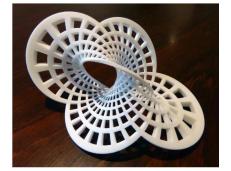
It’s my turn now to post about how much fun we had at Bridges!  One of the best parts of Bridges was seeing the art on display, both in the galleries and in the lobby where people were displaying and selling their works of art.  We spent a lot of time oogling over the 3D printed sculptures of Henry Segerman.  Henry is a research fellow at the University of Melbourne, in Australia, studying 3-dimensional geometry and topology.  The sculptures that he makes show how beautiful geometry and topology can be.
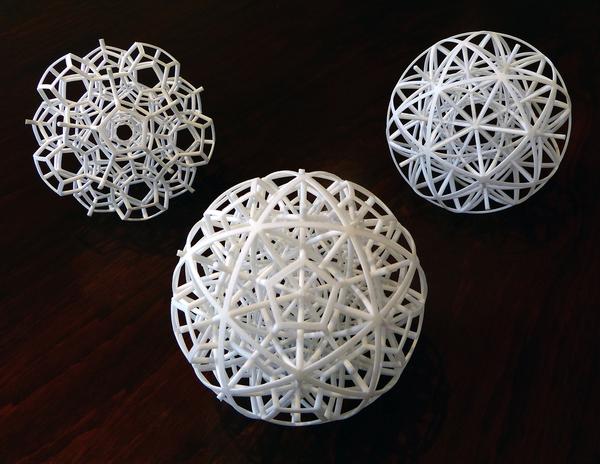
These are the sculptures that Henry had on display in the gallery at Bridges.  They won Best Use of Mathematics!  These are models of something called 4-dimensional regular polytopes.  A polytope is a geometric object with flat sides – like a polygon in two dimensions or a polyhedron in three dimensions.  4-dimensional polyhedra?  How can we see these in three dimensions?  The process Henry used to make something 4-dimensional at least somewhat see-able in three dimensions is called a stereographic projection.  Mapmakers use stereographic projections to show the surface of the Earth – which is a 3-dimensional object – on a flat sheet of paper – which is a 2-dimensional object.

A stereographic projection of the Earth.

To do a stereographic projection, you first set the sphere on the piece of paper, or plane.  It’ll touch the plane in exactly 1 point (and will probably roll around, but let’s pretend it doesn’t).  Next, you draw a straight line starting at the point at the top of the sphere, directly opposite the point set on the plane, going through another point on the sphere, and mark where that line hits the plane.  If you do that for every point on the sphere, you get a flat picture of the surface of the sphere.  The point where the sphere was set on the plane is drawn exactly where it was set – or is fixed, as mathematicians say.  The point at the top of the sphere… well, it doesn’t really have a spot on the map.  Mathematicians say that this point went to infinity.  Exciting!

A stereographic projection like this draws a 3-dimensional object in 2-dimensions.  The stereographic projection that Henry did shows a 4-dimensional object in 3-dimensions.  Henry first drew, or projected, the vertices of his 4-dimensional polytope onto a 4-dimensional sphere – or hypersphere.  Then he used a stereographic projection to make a 3D model of the polytope – and printed it out!  How beautiful!

Here are some more images of Henry’s 3D printed sculptures.  We particularly love the juggling one.

Henry will be dropping by to answer your questions! So if you have a question for him about his sculptures, the math he does, or something else, then leave it for him in the comments.

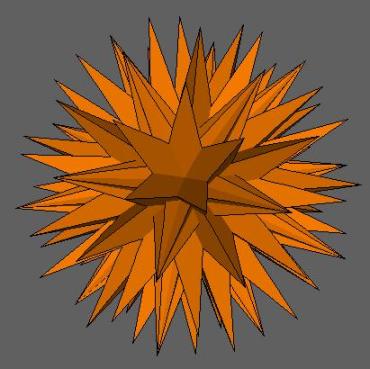
Speaking of polyhedra, check out this site of applets for visualizing polyhedra.  You can look at, spin, and get stats on all kinds of polyhedra – from the regular old cube to the majestic great stellated dodecahedron to the mindbogglingly complex uniform great rhombicosidodecahedron.  You can also practice your skills with Greek prefixes and suffixes.

Finally, two Math Munches ago, we told you about some videos made by the mathematical artist George Hart.  He’s the man who brought us the Yoshimoto cube.  And now he’s brought us… Pentadigitation.  In this video, George connects stars, knots, and rubber bands.  Enjoy watching – and trying the tricks!

Bon appetit!

Mike Naylor, Math Magic, and Mazes

Mathematical artist, Mike Naylor juggling 5 balls.

Welcome to this week’s Math Munch!

Last week, Justin told you about our time at Bridges 2012, the world’s largest conference of mathematics and art, and I must reiterate: this was one of the coolest things I’ve ever been a part of. The art was gorgeous. The people were great. I’m pretty sure I was beaming with excitement. At dinner we met, Mike Naylor, a mathematical artist and generally fantastic guy living in Norway. You can read his full artist’s statement and artwork from the Bridges exhibition, but here’s an excerpt:

“Much of my artwork focuses on the use of the human body to represent geometric concepts, but I also enjoy creating abstract works that capture mathematical ideas in ways that are pleasing, surprising and invite further reflection.”

Meeting Mike was especially exciting for me, because just days earlier, I’d fallen in love with Mike’s math blog. This week, I’ll be sharing some of the gems I’ve found there:

I didn’t even mention abacaba.org, yet another amazing Mike Naylor project.  It’s a site devoted entirely to one pattern: A, aBa, abaCaba, abacabaDabacaba,…

Since Justin introduced mathematical poetry last week, check out one of Mike’s mathematical poems called “Decision Tree.” What a clever idea! Like Mike, I’m a juggler, so I absolutely loved his Fractal Juggler animation, which shows a juggler juggling jugglers juggling jugglers… Clever idea #2! And for a third clever idea, check out the Knight Maze he designed. Wow!

“Decision Tree”

“Fractal Juggler”

“Knight Maze”

The most squares of whole area that will fit in a square of area 17.

Speaking of mazes, I found a whole bunch of cool ones when I was poking around the Math Magic site hosted by Stetson University. Each month Math Magic poses a math question for readers to work on and then submit their solutions. This month’s question is about packing squares in squares. (Click to see the submissions so far.)  At the bottom of the page you can find links to many more cool math sites, but as promised, I’ll share some of the mazes I found.

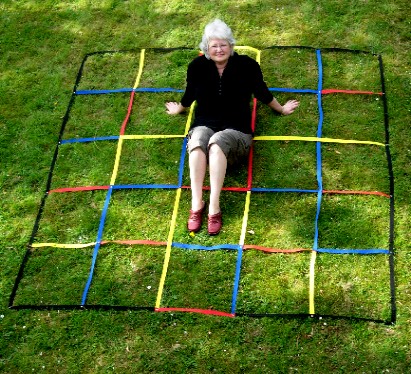
A puzzle designer for over 40 years, here Andrea Gilbert lays across one of her step-over sequence mazes.

First there’s Andrea Gilbert’s site, Click Mazes, which has all sorts of online mazes and puzzles.  In the picture you can see Andrea laying in one of her step-over sequence mazes.  How do you figure they work?

Then there’s Logic Mazes, a website of mazes by Robert Abbott. I don’t know much about Robert, but his site caught my eye because it begins with Five Easy Mazes: 1 2 3 4 5, but there are better mazes after that. I really liked the number mazes. Play around, think your way through, and have some fun!

Bon appetit!

Number Mazes

Eyeball Mazes

Alice Mazes

Bridges, Meander Patterns, and Water Sports

This past week the Math Munch team got to attend the Bridges 2012. Bridges is a mathematical art conference, the largest one in the world. This year it was held at Towson University outside of Baltimore, Maryland. The idea of the conference is to build bridges between math and the arts.

Participants gave lectures about their artwork and the math that inspired or informed it. There were workshop sessions about mathematical poetry and chances to make baskets and bead bracelets involving intricate patterns. There was even a dance workshop about imagining negative-dimensional space! There were also some performances, including two music nights (which included a piece that explored a Fibonacci-like sequence called Narayana’s Cows) and a short film festival (here are last year’s films). Vi Hart and George Hart talked about the videos they make and world-premiered some new ones. And at the center of it all was an art exhibition with pieces from around the world.

The Zen of the Z-Pentomino by Margaret Kepner

Does this piece by Bernhard Rietzl
remind you of a certain sweater?

5 Rhombic Screens by Alexandru Usineviciu

Pythagorean Proof by Donna Loraine

To see more, you should really just browse the Bridges online gallery.

A shot of the gallery exhibition

I know that Paul, Anna, and I will be sharing things with you that we picked up at Bridges for months to come. It was so much fun!

David Chappell

One person whose work and presentation I loved at Bridges is David Chappell. David is a professor of astronomy at the University of La Verne in California.

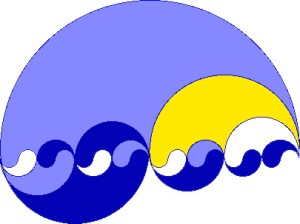
David shared some thinking and artwork that involve meander patterns. “Meander” means to wander around and is used to describe how rivers squiggle and flow across a landscape. David uses some simple and elegant math to create curve patterns.

Instead of saying where curves sit in the plane using x and y coordinates, David describes them using more natural coordinates, where the direction that the curve is headed in depends on how far along the curve you’ve gone. This relationship is encoded in what’s called a Whewell equation. For example, as you walk along a circle at a steady rate, the direction that you face changes at a contant rate, too. That means the Whewell equation of a circle might look like angle=distance. A smaller circle, where the turning happens faster, could be written down as angle=2(distance).

Look at how the Cauto River “meanders” across the Cuban landscape.

In his artwork, David explores curves whose equations are more complicated—ones that involve multiple sine functions. The interactions of the components of his equations allow for complex but rhythmic behavior. You can create meander patterns of your own by tinkering with an applet that David designed. You can find both the applet and more information about the math of meander patterns on David’s website.

David Chappell’s Meander #6
Make your own here!

When I asked David about how being a scientist affects his approach to making art, and vice versa, he said:

My research focuses on nonlinear dynamics and pattern formation in fluid systems. That is, I study the spatial patterns that arise when fluids are agitated (i.e. shaken or stirred). I think I was attracted to this area because of my interest in the visual arts. I’ve always been interested in patterns. The science allows me to study the underlying physical systems that generate the patterns, and the art allows me to think about how and why we respond to different patterns the way we do.  Is there a connection between how we respond to a visual image and the underlying “rules” that produced the image?  Why to some patterns look interesting, but others not so much?

For more of my Q&A with David, click here. In addition, David will be answering questions in the comments below, so ask away!

Since bridges and meandering rivers are both water-related, I thought I’d round out this post with a couple of interesting links about water sports and the Olympics. My springboard was a site called Maths and Sport: Countdown to the Games.

No wiggle rigs

Arrangements of rowers that are “wiggle-less”

Here’s an article that explores different arrangements of rowers in a boat, focusing on finding ones where the boat doesn’t “wiggle” as the rowers row. It’s called Rowing has its Moments.

Next, here’s an article about the swimming arena at the 2008 Beijing games, titled Swimming in Mathematics.


Paul used to be a competitive diver, and he says there’s an interesting code for the way dives are numbered.  For example, the “Forward 1 ½ Somersaults in Tuck Position” is dive number 103C.  How does that work?  You can read all about it here.  (Degree of difficulty is explained as well.)

Finally, enjoy these geometric patterns inspired by synchronized swimming!

Stay cool, and bon appetit!