Tag Archives: fractals

Mathematical Impressions, Modular Origami, and the Tenth Dimension

Welcome to this week’s Math Munch!

First up, check out the latest video in George Hart‘s series called “Mathematical Impressions.”  George has been making videos for “Mathematical Impressions,” which is sponsored by the Simons Foundation, since summer, when he made his video debut – so there are many videos to watch!  Here’s his newest video, called, “Attesting to Atoms,” about how the geometric structure of crystals gives clues to the existence of atoms.  (Click on the picture below to watch the video.)
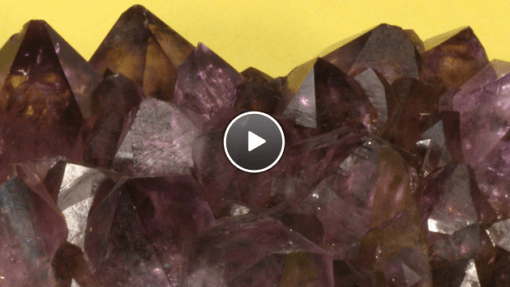
Atoms video

I love how this video shows a real way in which knowledge of mathematics – which can seem very abstract at times – can help us to understand the structure of the world, which is very concrete.  In this second video, one of my favorites, George talks about the reverse of that – allowing our knowledge of something concrete to help us understand abstract mathematics.  This video is called, “Knot Possible.”  (Again, click on the picture to watch the video!)

Knot video

I could have used these words of wisdom from George when I was thinking about the problem he poses in this video: “Don’t let your knowledge of mathematics artificially limit what you think is physically possible.  Quite to the contrary!  Mathematics is a tool which can empower us to do amazing things that no one has ever done before.”  Well said, George!

sierpinski-tetrahedron-tri-2Speaking of using mathematics to do and make amazing things, check out this website of modular origami models and patterns!

This site was put together by Michal Kosmulski, who lives in Poland and works in information technology.  In addition, however, he folds these amazing modular origami polyhedra, fractals, and other awesome mathematical objects!  Michal’s site is full of pictures of his modular origami creations and links to patterns for how to make them yourself as well as information about the mathematics behind the objects.  He has also included some useful tips on how to make the more challenging shapes.
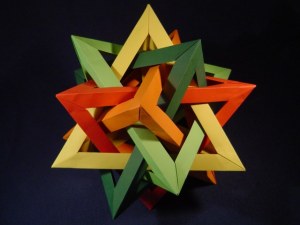
fit-five-intersecting-tetrahedra-60deg-2One of my favorites is the object to the left, “Five Intersecting Tetrahedra.”  I think that this structure is both beautiful and very interesting.  It can be made by intersecting five tetrahedra, or triangular-based pyramids, as shown, or by making a stellation of an icosahedron.  What does that mean?  Well, an icosahedron is a polyhedron with twenty equilateral triangular faces.  To stellate a polyhedron, you extend some element of the polyhedron – such as the faces or edges – in a symmetric way until they meet to form a new polyhedron.  There are 59 possible stellations of the icosahedron!  Michal has models of several of them, including the Five Intersecting Tetrahedra and the great stellated icosahedron shown below on the left.  The figure on the right is called “Cube.”

spiked-dodecahedron-ssitcube-oxi

Finally, all the talking about dimensions that we’ve been doing for the past few weeks reminded me of my favorite video about higher dimensions.  It’s called, “Imagining the Tenth Dimension,” and it shows a way of thinking about dimensions, from the zero dimension all the way up to the tenth.  I can watch this video again and again and still find it mind-blowing and fascinating.

Bon appetit!

Pixel Art, Gothic Circle Patterns, and First Past the Post

Welcome to this week’s Math Munch!

Guess what? Today is Math Munch’s one-year anniversary!

We’re so grateful to everyone who has made this year so much fun: our students and readers; everyone who has spread the word about Math Munch; and especially all the people who do and make the cool mathy things that we so love to find and share.

Speaking of which…

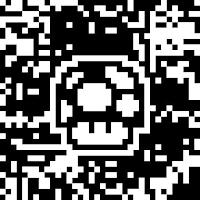
Mathematicians have studied the popular puzzle called Sudoku in numerous ways. They’ve counted the number of solutions. They’ve investigated how few given numbers are required to force a unique solution. But Tiffany C. Inglis came at this puzzle craze from another angle—as a way to encode pixel art!

Tiffany studies computer graphics at the University of Waterloo in Ontario, Canada. She’s a PhD candidate at the Computer Graphics Lab (which seems like an amazing place to work and study—would you check out these mazes!?)

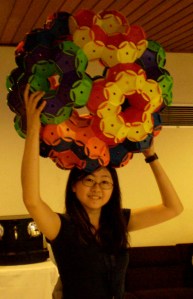
Tiffany C. Inglis, hoisting a buckyball

Tiffany tried to find shading schemes for Sudoku puzzles so that pictures would emerge—like the classic mushroom pictured above. Sudoku puzzles are a pretty restrictive structure, but Tiffany and her collaborators had some success—and even more when they loosened the rules a bit. You can read about (and see!) some of their results on this rad poster and in their paper.

Thinking about making pictures with Sudoku puzzles got Tiffany interested in pixel art more generally. “I did some research on how to create pixel art from generic images such as photographs and realized that it’s an unexplored area of research, which was very exciting!” Soon she started building computer programs—algorithms—to automatically convert smooth line art into blockier pixel art without losing the flavor of the original. You can read more about Tiffany’s pixelization research on this page of her website. You should definitely check out another incredible poster Tiffany made about this research!

To read more of my interview with Tiffany, you can click here.

Cartoon Tiffany explains what makes a good pixelization. Check out the full comic!

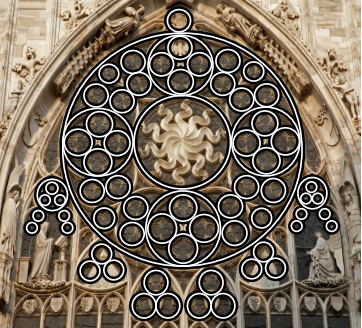
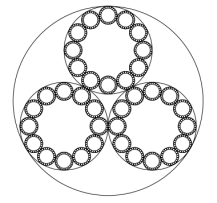
I met Tiffany this past summer at Bridges, where she both exhibited her artwork and gave an awesome talk about circle patterns in Gothic architecture. You may be familiar with Apollonian gaskets; Gothic circle patterns have a similar circle-packing feel to them, but they have some different restrictions. Circles don’t just squeeze in one at a time, but come in rings. It’s especially nice when all of the tangencies—the places where the circles touch—coincide throughout the different layers of the pattern. Tiffany worked on the problem of when this happens and discovered that only a small family has this property. Even so, the less regular circle patterns can still produce pleasing effects. She wrote about this and more in her paper on Gothic circle patterns.

I’m really inspired by how Tiffany finds new ideas in so many place, and how she pursues them and then shares them in amazing ways. I hope you’re inspired, too!

A rose window at the Milan Cathedral, with circle designs highlighted.

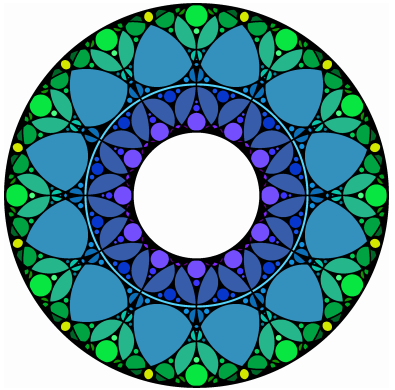
A mathematical model similar to the window, which Tiffany created.

An original design by Tiffany. All of these images are from her paper.

Here’s another of Tiffany’s designs. Now try making one of your own!

Using the Mathematica code that Tiffany wrote to build her diagrams, I made an applet where you can try making some circle designs of your own. Check it out! If you make one you really like—and maybe color it in—we’d love to see it! You can send it to us at MathMunchTeam@gmail.com.

(You’ll may have to download a plug-in to view the applet; it’s the same plug-in required to use the Wolfram Demonstrations Project.)

Finally, with Election Day right around the corner, how about a dose of the mathematics of voting?

I’m a fan of this series of videos about voting theory by C.G.P. Grey. Who could resist the charm of learning about the alternative vote from a wallaby, or about gerrymandering from a weasel? Below you’ll find the first video in his series, entitled “The Problems with First Past the Post Voting Explained.” Majority rule isn’t as simple of a concept as you might think, and math can help to explain why. As can jungle animals, of course.

Thanks again for being a part of our Math Munch fun this past year. Here’s to a great second course! Bon appetit!


PS I linked to a bunch of papers in this post. After all, that’s the traditional first anniversary gift!

Demonstrations, a Number Tree, and Brainfilling Curves

Welcome to this week’s Math Munch!

Maybe you’re headed back to school this week. (We are!) Or maybe you’ve been back for a few weeks now. Or maybe you’ve been out of school for years. No matter which one it is, we hope that this new school year will bring many new mathematical delights your way!

A website that’s worth returning to again and again is the Wolfram Demonstrations Project (WDP). Since it was founded in 2007, users of the software package Mathematica have been uploading “demonstrations” to this website—amazing illuminations of some of the gems of mathematics and the sciences.

Each demonstration is an interactive applet. Some are very simple, like one that will factor any number up to 10000 for you. Others are complex, like this one that “plots orbits of the Hopalong map.”

Some demonstrations are great for visualizing facts about math, like these:

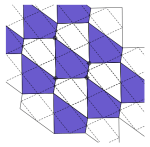
Any Quadrilateral Can Tile

A Proof of Euler’s Formula

Cube Net or Not?

There’s also a whole category of demonstrations that can be used as MArTH—mathematical art—tools, including these:

Rotate and Fold Back

Polygons Arranged in a Circle

Turtle Fractals

With over 8000 demonstrations to explore and new ones being added all the time, you can see why the Wolfram Demonstrations Project is worth returning to again and again!

Jeffrey Ventrella’s Number Tree

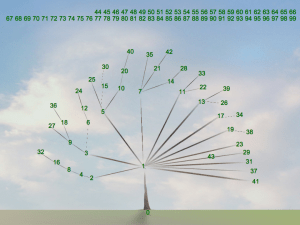
Next up, check out this number tree. It was created by Jeffrey Ventrella, an innovator, artist, and computer programmer who lives in San Francisco. His number tree arranges the numbers from 1 to 100 according to their largest proper factors. For instance, the factors of 18 are 18, 9, 6, 3, 2, and 1. Once we toss out 18 itself as being “improper”—a.k.a. “uninteresting”—the largest factor of 18 is 9. This in turn has as its largest factor 3, and 3 goes down to 1. Chains of factors like this one make up Jeffrey’s tree. It has a wonderful accumulative feeling to it—it’s great to watch how patterns and complexity build up over time.

(On this theme, WDP also has a demonstrations about trees and about prime factorization graphs.)

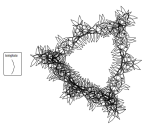
Cloctal: “a fractal design that visualizes the passage of time”

There’s lots more math to explore on Jeffrey’s website. His piece Cloctal—a fractal clock—is one of my favorites. What I’d like to feature here, though, is the diverse and intricate work Jeffrey has done with plane-filling and space-filling curves.  You can find many examples at fractalcurves.com, Jeffrey’s website that’s chock full of great links.

Jeffrey recently completed a book called Brainfilling Curves. It’s “a visual math expedition, lead by a lifelong fractal explorer.” According to the description, the book picks up where Mandelbrot left off and develops an intuitive scheme for understanding an “infinite universe of fractal beauty.”

An example of a “brainfilling curve” from Jeffrey’s “root8” family

The title comes from the idea that nature uses space-filling curves quite often, to pack intestines into your gut or lots and lots of tissue into the brain you’re using to read this right now! Hopefully you’re finding all of this math quite brainfilling as well.

(And just one more example of why WDP is worth revisiting: here’s a demonstration that depicts the space-filling Hilbert and Moore curves. So much good stuff!)

Finally, here’s a video that Jeffrey made about brainfilling curves. You can find more on his YouTube channel.

Bon appetit!