Welcome to this week’s Math Munch!
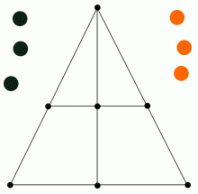
Board and pieces for tsoro yematatu.
Here’s a little game with a big name: tsoro yematatu. If you enjoyed Paul’s recent post about tic-tac-toe, I think you’ll like tsoro yematatu a lot.
I ran across this game on a website called Behind the Glass. The site is run by the Cincinnati Art Museum. (What is it with me and art museums lately?) The museum uses Behind the Glass to curate many pieces of African art and culture, including four mathematical games that are played in Africa.
The simplest of these is tsoro yematatu. It has its origin in Zimbabwe. Like tic-tac-toe, the goal is to get three of your pieces in a row, but the board is “pinched” and you can move your pieces. Here’s an applet where you can play a modified version of the game against a computer opponent. While the game still feels similar to tic-tac-toe, there are brand-new elements of strategy.
Tsoro yematatu reminds me of one that I played as a kid called Nine Men’s Morris. I learned about it and many other games—including go—from a delightful book called The Book of Classic Board Games. Kat Mangione—a teacher, mom, and game-lover who lives in Tennessee—has compiled a wonderful collection of in-a-row games. And wouldn’t you know, she includes Nine Men’s Morris, tsoro yematatu, tic-tac-toe, and dara—another of the African games from Behind the Glass.

The Fano plane.
The board for tsoro yematatu also reminds me of the Fano plane. This mathematical object is very symmetric—even more than meets the eye. Notice that each point is on three lines and that each line passes through three points. The Fano plane is one of many projective planes—mathematical objects that are “pinched” in the sense that they have vanishing points. They are close cousins of perspective drawings, which you can check out in these videos.
Can you invent a game that can be played on the Fano plane?
Closely related to the Fano plane is an object called the Klein quartic. They have the same symmetries—168 of them. Felix Klein discovered not only the Klein quartic and the famous Klein bottle, but also the gorgeous Kleinian groups and the Beltrami-Klein model. He’s one of my biggest mathematical heroes.

The Klein quartic.
This article about the Klein quartic by mathematician John Baez contains some wonderful images. The math gets plenty tough as the article goes on, but in a thoughtfully-written article there is something for everyone. One good way to learn about new mathematics is to read as far as you can into a piece of writing and then to do a little research on the part where you get stuck.
If you’ve enjoyed the animation of the Klein quartic, then I bet my last find this week will be up your alley, too. It’s a Tumblr by David Whyte and Brian Fitzpatrick called Bees & Bombs. David and Brian create some fantastic GIFs that can expand your mathematical imagination.
This one is called Pass ‘Em On. I find it entrancing—there’s so much to see. You can follow individual dots, or hexagons, or triangles. What do you see?

This one is called Blue Tiles. It makes me wonder what kind of game could be played on a shape-shifting checkerboard. It also reminds me of parquet deformations.

A few of my other favorites are Spacedots and Dancing Squares. Some of David and Brian’s animations are interactive, like Pointers. They have even made some GIFs that are inspired by Tilman Zitzmann’s work over at Geometry Daily (previously).
I hope you enjoy checking out all of these new variations on some familiar mathematical objects. Bon appetit!


 Math Munch