Tag Archives: arithmetic

Prime Gaps, Mad Maths, and Castles

Welcome to this week’s Math Munch!

It has been a thrilling last month in the world of mathematics. Several new proofs about number patterns have been announced. Just to get a flavor for what it’s all about, here are some examples.

I can make 15 by adding together three prime numbers: 3+5+7. I can do this with 49, too: 7+11+31. Can all odd numbers be written as three prime numbers added together? The Weak Goldbach Conjecture says that they can, as long as they’re bigger than five. (video)

11 and 13 are primes that are only two apart. So are 107 and 109. Can we find infinitely many such prime pairs? That’s called the Twin Prime Conjecture. And if we can’t, are there infinitely many prime pairs that are at most, say, 100 apart? (video, with a song!)

Harald Helfgott

Harald Helfgott

Yitang "Tom" Zhang

Yitang “Tom” Zhang

People have been wondering about these questions for hundreds of years. Last month, Harald Helfgott showed that the Weak Goldbach Conjecture is true! And Yitang “Tom” Zhang showed that there are infinitely many prime pairs that are at most 70,000,000 apart! You can find lots of details about these discoveries and links to even more in this roundup by Evelyn Lamb.

What’s been particularly fabulous about Tom’s result about gaps between primes is that other mathematicians have started to work together to make it even better. Tom originally showed that there are an infinite number of prime pairs that are at most 70,000,000 apart. Not nearly as cute as being just two apart—but as has been remarked, 70,000,000 is a lot closer to two than it is to infinity! That gap of 70,000,000 has slowly been getting smaller as mathematicians have made improvements to Tom’s argument. You can see the results of their efforts on the polymath project. As of this writing, they’ve got the gap size narrowed down to 12,006—you can track the decreasing values down the page in the H column. So there are infinitely many pairs of primes that are at most 12,006 apart! What amazing progress!

Two names that you’ll see in the list of contributors to the effort are Andrew Sutherland and Scott Morrison. Andrew is a computational number theorist at MIT and Scott has done research in knot theory and is at the Australian National University. They’ve improved arguments and sharpened figures to lower the prime gap value H. They’ve contributed by doing things like using a hybrid Schinzel/greedy (or “greedy-greedy”) sieve. Well, I know what a sieve is and what a greedy algorithm is, but believe me, this is very complicated stuff that’s way over my head. Even so, I love getting to watch the way that these mathematicians bounce ideas off each other, like on this thread.

Andrew Sutherland

Andrew Sutherland

Click through to see Andrew next to an amazing Zome creation!

Andrew. Click this!

Scott Morrison

Scott Morrison

Andrew and Scott have agreed to answer some of your questions about their involvement in this research about prime gaps and their lives as mathematicians. I know I have some questions I’m curious about! You can submit your questions in the form below:

I can think of only two times in my life where I was so captivated by mathematics in the making as I am by this prime gaps adventure. Andrew Wiles’s proof of Fermat’s Last Theorem was on the fringe of my awareness when it came out in 1993—its twentieth anniversary of his proof just happened, in fact. The result still felt very new and exciting when I read Fermat’s Enigma a couple of years later. Grigori Perelman’s proof of the Poincare Conjecture made headlines just after I moved to New York City seven years ago. I still remember reading a big article about it in the New York Times, complete with a picture of a rabbit with a grid on it.

This work on prime gaps is even more exciting to me than those, I think. Maybe it’s partly because I have more mathematical experience now, but I think it’s mostly because lots of people are helping the story to unfold and we can watch it happen!

fig110u2bNext up, I ran across a great site the other week when I was researching the idea of a “cut and slide” process. The site is called Mad Maths and the page I landed on was all about beautiful dissections of simple shapes, like circles and squares. I’ve picked out one that I find especially charming to feature here, but you might enjoy seeing them all. The site also contains all kinds of neat puzzles and problems to try out. I’m always a fan of congruent pieces problems, and these paper-folding puzzles are really tricky and original. (Or maybe, origaminal!) You’ll might especially like them if you liked Folds.
Christian's applet displaying the original four-room castle.

Christian’s applet displaying the original four-room castle.

Finally, we previously posted about Matt Parker’s great video problem about a princess hiding in a castle. Well, Christian Perfect of The Aperiodical has created an applet that will allow you to explore this problem—plus, it’ll let you build and try out other castles for the princess to hide in. Super cool! Will I ever be able to find the princess in this crazy star castle I designed?!

Crazy star castle!

My crazy star castle!

And as summer gets into full swing, the other kind of castle that’s on my mind is the sandcastle. Take a peek at these photos of geometric sandcastles by Calvin Seibert. What shapes can you find? Maybe Calvin’s creations will inspire your next beach creation!

Bon appetit!

167739151_ec142bbfe8 3342635687_f847918e0e 5945114420_c950231830

We Use Math, Integermania, and Best-of-Seven

Welcome to this week’s Math Munch!

astronaut“When will I use math?” Have you ever asked this question? Well, then you are in for a treat, because the good people of We Use Math have some answers for you! This site was created by the Math Department at Brigham Young University to help share information about career paths that are opened up by studying mathematics. Here’s their introductory video:

The We Use Math site shares write-ups about a wide range of career opportunities that involve doing mathematics. I was glad to learn more about less-familiar mathy careers like technical writing and cost estimation. Also, my brother has studied some operations management in college, so it was great to read the overview of that line of work. In addition, the We Use Math site has pages about recent math discoveries and about unsolved math problems. Check them out!

Next up is one of my long-time favorite websites: Integermania!

Perhaps you’ve heard of the four 4’s problem before. Using four 4’s and some arithmetic operations, can you make the numbers from 1 to 20? Or even higher? Some numbers are easy to make, like 16. It’s 4+4+4+4. Some are sneakier, like 1. One way it can be created is (4+4)/(4+4). But what about 7? Or 19? This is a very common type of problem in mathematics—which math objects of a certain type can be built with limited tools?

swilson21-e1315080873212

Steven J. Wilson

Integermania is a website where people from around the world have submitted number creations made of four small numbers and operations. It’s run by Steven J. Wilson, a math professor at Johnson County Community College in Kansas. (Steven has even more great math resources at his website Milefoot.com)

There are many challenges at Integermania: four 4’s, the first four prime numbers, the first four odds, and even the digits of Ramanujan’s famous taxicab number (1729).

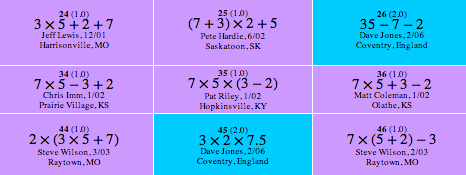
Here are some number creations made of the first four prime numbers. Can you make some of your own?

Here are some number creations made of the first four prime numbers.
Can you make some of your own?

One of my favorite aspects of Integermania is the way it rates number creations by “exquisiteness level“. If a number creation is made using only simple operations—like addition or multiplication—then it’s regarded as more exquisite than if it uses operations like square roots or percentages. I also love how Integermania provides an opportunity for anyone to make their mark in the big world of mathematical research—it’s like scrawling a mathematical “I wuz here!” After years of visiting the site, I just submitted for the first time some number creations of my own. I’ll let you know how it goes, and I’d love to hear about it if you decide to submit, too.

Here are recaps of all the World Series since 1903 from MLB.com

Here are recaps of all the World Series since 1903 from MLB.com

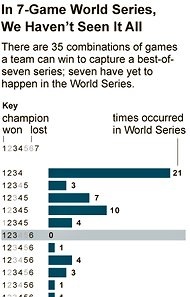
Now coming to the plate: my final link of the week! Monday was the first day of the new Major League Baseball season. I want to share with you a New York Times article from last December. It’s called Keeping Score: Over in Four About a Fifth of the Time. The article digs into the outcomes of all of the World Series championships—not so much who won as how they won. It takes four victories to win a seven-game series, and there are 35 different ways that a best-of-seven series can play out, put in terms of wins and losses for the overall winner. For instance, a clean sweep would go WWWW, while another sequence would be WWLLWW. The article examines which of these win-loss sequences have been the most common in the World Series.

(Can you figure out why there are 35 possible win-loss sequences in a seven-game series? What about for a best-of-five series? And what if we tried to model the outcome of a series by assuming each team has a fixed chance of winning each game?)

worldseriesstats

A clip of the stats that are displayed in the Times article. Click through to see it all.

I was curious to know if the same results held true in other competitions. Are certain win-loss sequences rare across different sports? Are “sweeps” the most common outcome? After sifting through Wikipedia for a while, I was able to compile the statistics about win-loss sequences for hockey’s Stanley Cup Finals. This has been a best-of-seven series since 1939, and it has been played 73 times since then. (It didn’t happen in 2005 because of a lockout.) You can see the results of my research in this document. Two takeaways: sweeps are also the most common result in hockey, but baseball more frequently requires the full seven games to determine a winner.

It could be a fun project to look at other best-of-seven series, like the MLB’s League Championship Series or basketball’s NBA Finals. If you pull that data together, let us know in the comments!

Batter up, and bon appetit!

******

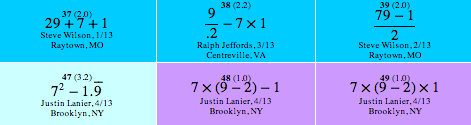
UPDATE (4/4/13): My first set of five number creations was accepted and are now posted on the Ramanujan challenge page. Here are the three small ones! Can you find a more exquisite way of writing 47 than I did?

myintegermania

Sandpiles, Prime Pages, and Six Dimensions of Color

Welcome to this week’s Math Munch!

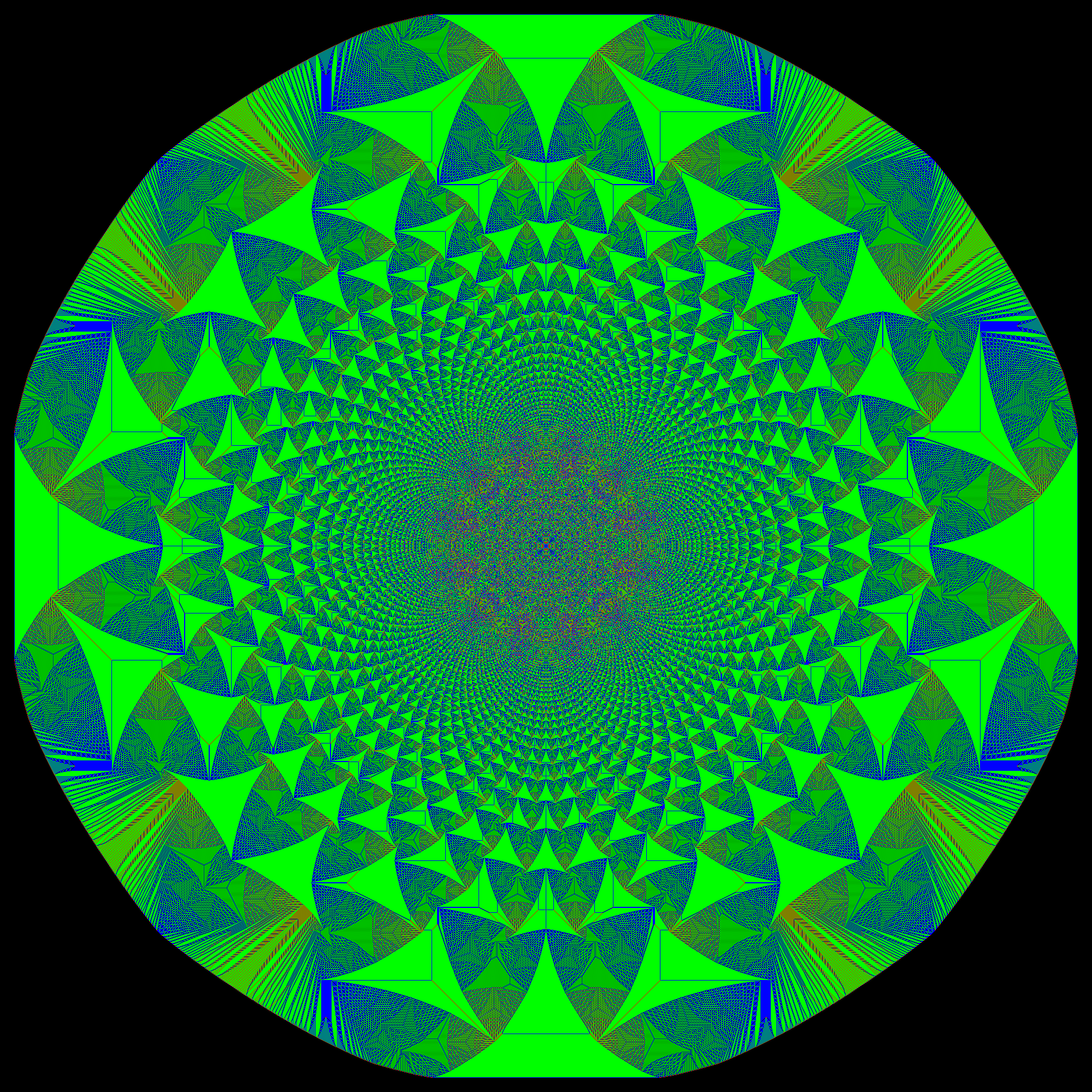
Four million grains of sand dropped onto an infinite grid. The colors represent how many grains are at each vertex. From this gallery.

We got our first snowfall of the year this past week, but my most recent mathematical find makes me think of summertime instead. The picture to the right is of a sandpile—or, more formally, an Abelian sandpile model.

If you pour a bucket of sand into a pile a little at a time, it’ll build up for a while. But if it gets too tall, an avalanche will happen and some of the sand will tumble away from the peak. You can check out an applet that models this kind of sand action here.

A mathematical sandpile formalizes this idea. First, take any graph—a small one, a medium sided one, or an infinite grid. Grains of sand will go at each vertex, but we’ll set a maximum amount that each one can contain—the number of edges that connect to the vertex. (Notice that this is four for every vertex of an infinite square grid). If too many grains end up on a given vertex, then one grain avalanches down each edge to a neighboring vertex. This might be the end of the story, but it’s possible that a chain reaction will occur—that the extra grain at a neighboring vertex might cause it to spill over, and so on. For many more technical details, you might check out this article from the AMS Notices.

This video walks through the steps of a sandpile slowly, and it shows with numbers how many grains are in each spot.

A sandpile I made with Sergei’s applet

You can make some really cool images—both still and animated—by tinkering around with sandpiles. Sergei Maslov, who works at Brookhaven National Laboratory in New York, has a great applet on his website where you can make sandpiles of your own.

David Perkinson, a professor at Reed College, maintains a whole website about sandpiles. It contains a gallery of sandpile images and a more advanced sandpile applet.

Hexplode is a game based on sandpiles.

I have a feeling that you might also enjoy playing the sandpile-inspired game Hexplode!

Next up: we’ve shared links about Fibonnaci numbers and prime numbers before—they’re some of our favorite numbers! Here’s an amazing fact that I just found out this week. Some Fibonnaci numbers are prime—like 3, 5, and 13—but no one knows if there are infinitely many Fibonnaci primes, or only finitely many.

A great place to find out more amazing and fun facts like this one is at The Prime Pages. It has a list of the largest known prime numbers, as well as information about the continuing search for bigger ones—and how you can help out! It also has a short list of open questions about prime numbers, including Goldbach’s conjecture.

Be sure to peek at the “Prime Curios” page. It contains intriguing facts about prime numbers both large and small. For instance, did you know that 773 is both the only three-digit iccanobiF prime and the largest three-digit unholey prime? I sure didn’t.

Last but not least, I ran across this article about how a software company has come up with a new solution for mixing colors on a computer screen by using six dimensions rather than the usual three.

Dimensions of colors, you ask?

The arithmetic of colors!

Well, there are actually several ways that computers store colors. Each of them encodes colors using three numbers. For instance, one method builds colors by giving one number each to the primary colors yellow, red, and blue. Another systems assigns a number to each of hue, saturation, and brightness. More on these systems here. In any of these systems, you can picture a given color as sitting within a three-dimensional color cube, based on its three numbers.

A color cube, based on the RGB (red, green, blue) system.

If you numerically average two colors in these systems, you don’t actually end up with the color that you’d get by mixing paint of those two colors. Now, both scientists and artists think about combining colors in two ways—combining colored lights and combining colored pigments, or paints. These are called additive and subtractive color models—more on that here. The breakthrough that the folks at the software company FiftyThree made was to assign six numbers to each color—that is, to use both additive and subtractive ideas at the same time. The six numbers assigned to a given number can be thought of as plotting a point in a six-dimensional space—or inside of a hyper-hyper-hypercube.

I think it’s amazing that using math in this creative way helps to solve a nagging artistic problem. To get a feel for why mixing colors using the usual three-coordinate system is such a problem, you might try your hand at this color matching game. For even more info about the math of color, there’s some interesting stuff on this webpage.

Bon appetit!