Tag Archives: games

Sandpiles, Prime Pages, and Six Dimensions of Color

Welcome to this week’s Math Munch!
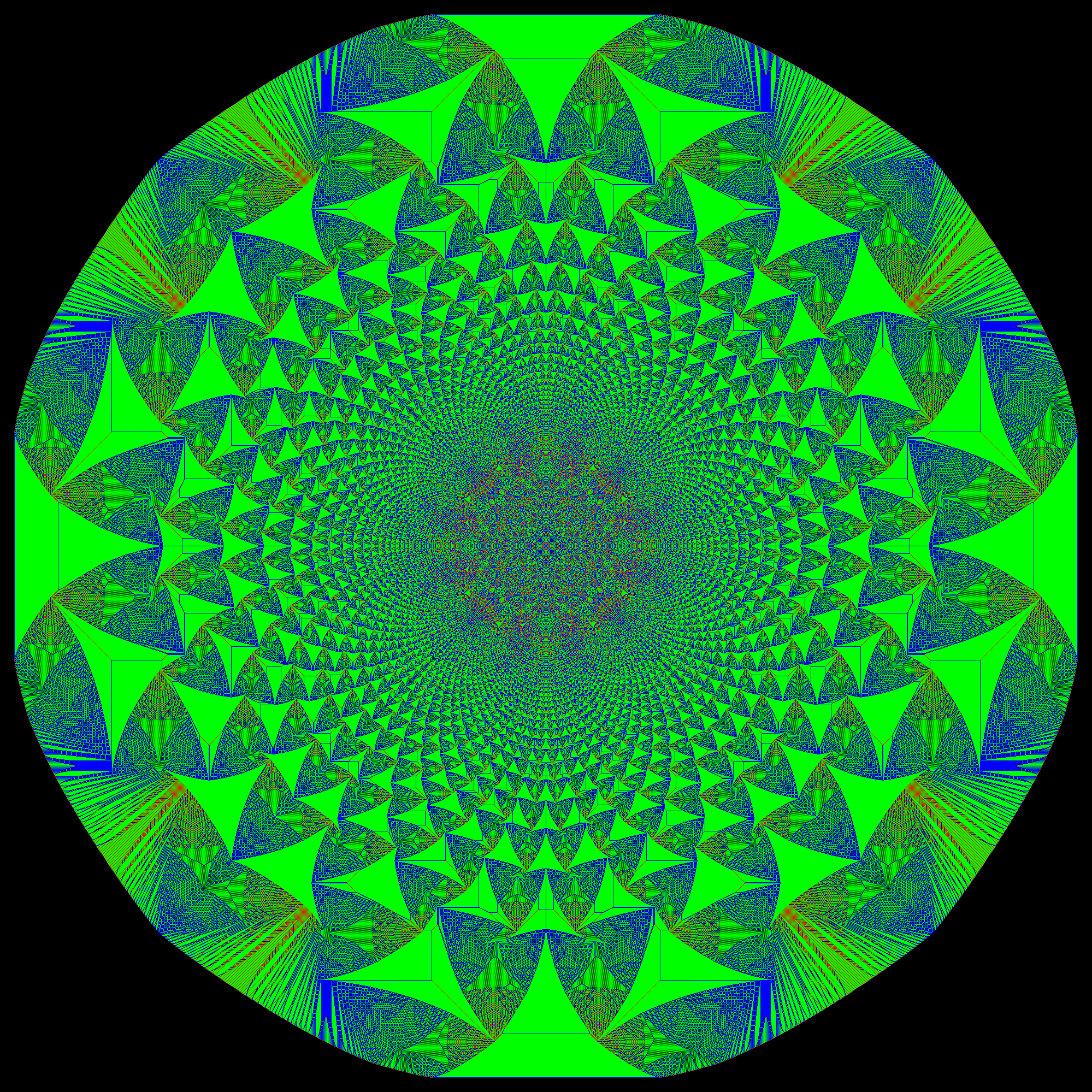
Four million grains of sand dropped onto an infinite grid. The colors represent how many grains are at each vertex. From this gallery.

We got our first snowfall of the year this past week, but my most recent mathematical find makes me think of summertime instead. The picture to the right is of a sandpile—or, more formally, an Abelian sandpile model.

If you pour a bucket of sand into a pile a little at a time, it’ll build up for a while. But if it gets too tall, an avalanche will happen and some of the sand will tumble away from the peak. You can check out an applet that models this kind of sand action here.

A mathematical sandpile formalizes this idea. First, take any graph—a small one, a medium sided one, or an infinite grid. Grains of sand will go at each vertex, but we’ll set a maximum amount that each one can contain—the number of edges that connect to the vertex. (Notice that this is four for every vertex of an infinite square grid). If too many grains end up on a given vertex, then one grain avalanches down each edge to a neighboring vertex. This might be the end of the story, but it’s possible that a chain reaction will occur—that the extra grain at a neighboring vertex might cause it to spill over, and so on. For many more technical details, you might check out this article from the AMS Notices.

This video walks through the steps of a sandpile slowly, and it shows with numbers how many grains are in each spot.

A sandpile I made with Sergei’s applet

You can make some really cool images—both still and animated—by tinkering around with sandpiles. Sergei Maslov, who works at Brookhaven National Laboratory in New York, has a great applet on his website where you can make sandpiles of your own.

David Perkinson, a professor at Reed College, maintains a whole website about sandpiles. It contains a gallery of sandpile images and a more advanced sandpile applet.

Hexplode is a game based on sandpiles.

I have a feeling that you might also enjoy playing the sandpile-inspired game Hexplode!

Next up: we’ve shared links about Fibonnaci numbers and prime numbers before—they’re some of our favorite numbers! Here’s an amazing fact that I just found out this week. Some Fibonnaci numbers are prime—like 3, 5, and 13—but no one knows if there are infinitely many Fibonnaci primes, or only finitely many.

A great place to find out more amazing and fun facts like this one is at The Prime Pages. It has a list of the largest known prime numbers, as well as information about the continuing search for bigger ones—and how you can help out! It also has a short list of open questions about prime numbers, including Goldbach’s conjecture.

Be sure to peek at the “Prime Curios” page. It contains intriguing facts about prime numbers both large and small. For instance, did you know that 773 is both the only three-digit iccanobiF prime and the largest three-digit unholey prime? I sure didn’t.

Last but not least, I ran across this article about how a software company has come up with a new solution for mixing colors on a computer screen by using six dimensions rather than the usual three.

Dimensions of colors, you ask?

The arithmetic of colors!

Well, there are actually several ways that computers store colors. Each of them encodes colors using three numbers. For instance, one method builds colors by giving one number each to the primary colors yellow, red, and blue. Another systems assigns a number to each of hue, saturation, and brightness. More on these systems here. In any of these systems, you can picture a given color as sitting within a three-dimensional color cube, based on its three numbers.

A color cube, based on the RGB (red, green, blue) system.

If you numerically average two colors in these systems, you don’t actually end up with the color that you’d get by mixing paint of those two colors. Now, both scientists and artists think about combining colors in two ways—combining colored lights and combining colored pigments, or paints. These are called additive and subtractive color models—more on that here. The breakthrough that the folks at the software company FiftyThree made was to assign six numbers to each color—that is, to use both additive and subtractive ideas at the same time. The six numbers assigned to a given number can be thought of as plotting a point in a six-dimensional space—or inside of a hyper-hyper-hypercube.

I think it’s amazing that using math in this creative way helps to solve a nagging artistic problem. To get a feel for why mixing colors using the usual three-coordinate system is such a problem, you might try your hand at this color matching game. For even more info about the math of color, there’s some interesting stuff on this webpage.

Bon appetit!

Pentago, Geometry Daily, and The OEIS

Welcome to this week’s Math Munch!

Pentago Board

Hurricane Sandy is currently slamming the East coast, but the Math Munch Team is safe and sound, so the math must go on.  First up, if you’ve visited our games page lately, you may have noticed a recent addition.  Pentago is a 2-player strategy with simple rules and an enticing twist.

  • Rules: Take turns playing stones.  The first person to get 5 in a row wins.  (5 is the “pent” part.)
  • Twist: After you place a stone you must spin one of the 4 blocks.  This makes things very interesting.

Why don’t you play a few games before you read on?  You can play the computer on their website, play with a friend by email, or download the Pentago iPhone app.  But if you’re ready, let’s dig into some Pentago strategy and analysis.

Mindtwister CEO, Monica Lucas

Mindtwister (the company that sells Pentago) put out a free strategy guide that names 4 different kinds of winning lines and rates their relative strengths.  The weakest strategy is called Monica’s Five, and it’s named after Mindtwister CEO and Pentago lover, Monica Lucas.  You can read our Q&A for more expert game strategies and insights.  We also had a chance to speak with Tomas Floden, the inventor of Pentago, so it’s a double Q&A week.

As you play, you start to build your own strategy guide, so let me share three basic rules from mine.  I call them the first 3 Pentago Theorems.  (A theorem is a proven math fact.)

  1. If you have a move to win, take it!  This one is obvious, but you’ll see why I include it.
  2. If your opponent is only missing one stone from a line of 5 you must play there.  It seems like you could play somewhere else and spin the line apart, but your opponent can play the stone and spin back!  The only exception to this rule is rule 1.  If you can win, just do that!
  3. 4 in a row, with both ends open will (almost always) win.  This is a classic double trap.  Either end will finish the winning line, so by rule 2 both must be filled, but this is impossible.  The exceptions of course will come when your opponent is able to win right away, so you still have to pay close attention.

Up next, check out the beautiful math art of Geometry Daily.

#288 Fundamental

#132 Eight Squares

#259 Dudeney’s Dissection

#296 Downpour

#236 Nova

#124 Cuboctahedron

#136 Tesseract

#26 Pentaflower

#92 Circular Spring

The site is the playground for the geometrical ideas of Tilman Zitzmann, a German designer and teacher, who’s been creating a new image every day for almost a year now!  He also took some time to write about his creative process, so if you’re interested, have a read.  Visit the Geometry Daily archives to view all the images.

Finally, an amazing resource – the On-Line Encyclopedia of Integer Sequences.  What’s the pattern here?  1, 3, 6, 10, 15, 21, …  Any idea?  Do you know what the 50th number would be?  Well if you type this sequence into the OEIS, it’ll tell you every known sequence that matches.  Here’s what you get in this case.  These are the “triangular numbers,” also the number of edges in a complete graph.  It also tells you formula for the sequence:

  • a(n) = C(n+1,2) = n(n+1)/2 = 0+1+2+…+n.

If you make n=1, then you get 1.  If n=2, then you get 3.  If n=5, you get the 5th number, so to get the 50th number in the sequence, we just make n=50 in the formula.  n(n+1)/2 becomes 50(50+1)/2 = 1275.  Nifty.  Who’s got a pattern that needs investigating?

Have a great week, and bon appetit!

Algorithmic House, Billiards, and Picma

Welcome to this week’s Math Munch!

Check out this beautiful building:

This is the Endesa Pavilion, located in Barcelona, Spain.  It’s also called Solar House 2.0, and that’s because the tops of all of those pyramid-spikes are covered in solar panels.  But that’s not all – this house was designed to best capture sunlight in the exact location it was built using a mathematical algorithm.

To build this house, architect Rodrigo Rubio, who works for the Institute for Advanced Architecture of Catalonia, first tracked the path of the sun over the spot he wanted to build the house.  He then plugged that data into a computer program.  This program is a set of mathematical steps called an algorithm that turns data about the movement of the sun in the sky into a geometric building.  The building it creates is the best – or optimal – building for that spot.

It puts solar panels in locations on the building that get the most sunlight and orients them to get the most exposure.  It places windows of different sizes and overhangs at different angles around the house to get the best ventilation, block sunlight from entering the house, and keep the house cool in the summer and warm in the winter.   And, because it’s an algorithm, it can be used to design the optimal house for any location.  The program then creates a pattern for the wooden pieces that make up the house.  This pattern can be sent to a machine that cuts out the pieces, which builders put together like a puzzle.

In this video, Rodrigo explains how the building was designed, how the design works, and how this design can be used to make eco-friendly houses all over the world.

[youtube http://www.youtube.com/watch?v=3R1CBFBxuew&feature=player_embedded]

Next, have you ever played billiards?  Maybe you’ve played pool or watched Donald Duck play billiards.  It’s interesting to see how a pool ball moves around on a rectangular billiards table, which is how the table is usually shaped.  But it’s even more interesting to see how a ball moves around on a triangular, pentagonal, circular, or elliptical billiards table!

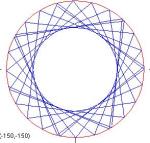
Want to try?  Check out this series of applets from Serendip, an exploratory math and science website started by some professors at Bryn Mawr College in Pennsylvania.  Serendip aims to help people ask and answer their own questions about the world we live in.  In these billiards applets, you can explore dynamical systems – mathematical structures in which an object moves according to a rule.   In some situations, the object will move in a predictable way.  But in other situations, the object moves chaotically.  As you play with the applets, see if you can figure out how the shape of the table effects whether the billiard ball will move chaotically or predictably.  These applets also make some beautiful star-like designs!

Finally, here’s a new game: Picma Squared.  In this game, you use logic to figure out how to color the squares in the grid to make a picture.  It starts out simple, but the higher levels are really challenging!  Enjoy!


Look for this game and others on our Games page!


Bon appetit!