Tag Archives: applet

Mayans, Calendars, and Ramanujan

Welcome to this week’s Math Munch!

There’s been a lot of fuss recently about the Mayan calendar and the “end of the world.” You’ll be relieved to hear that the world continues to hang in there. In fact, no less an authority than NASA put out a video to help clear up the misinformation surrounding the rolling over of the Mayan calendar.

mayanAll of the doomsday talk did get me researching the Mayan calendar and number system. Check out this page that discusses Mayan numerals and will even count and skip-count for you. Once you’ve got the knack of how to count in the Mayan system, maybe you’ll want to try to decipher the numbers on a Mayan ballcourt marker in this interactive applet.

A cool fact that I learned from that first page is that the Mayans also had another and fancier way of writing down numbers: face glyphs. I found a really comprehensive article by Mark Pitts that describes both face glyphs and the ordinary system, too.

glyphs

The Mayan face glyphs for 0, 1, 2, and 3:
mih, jun, cha’, and ux.

There are many interesting kinds of calendars that human being have developed over the centuries, all with different styles, different mathematical patterns, and different connections to the natural and human worlds. We’ve featured the Cloctal before, but how about some links to some other fun mathy calendars as the new year approaches?
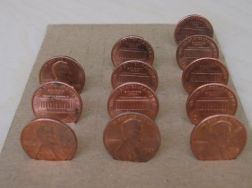
Thursday-January-1

Thursday, January 1—in pennies.

I’m always amazed by what the internet produces when I dream up a search term like “binary calendar.” Perhaps you’ve seen a binary clock before—if not, check out this one—but I was delighted to find several different takes on a binary calendar served up by Google. Juan Osborne designed a binary calendar with all of the dates written out it a big colorful loop. Next, can you figure out the secret to this wooden binary calendar by Ken and Bobbie Ralphs? (It’s a lot like a marble calculator.) And third, here’s a binary calendar that you can make using just twelve pennies, courtesy of exploringbinary.com!
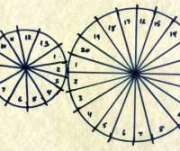
aztec-calendar-wheels

The Aztec tonalpohualli calendar.

There are many more amazing calendars to explore. Maybe you’ll check out Aztec calendar wheels, or find out about anniversaries of mathematicians from this calendar. (Isaac Newton was born on Christmas!) There are even more great calendars to explore at the Calendar Wiki, including some new calendars that have been proposed to “fix” our calendar—the Gregorian calendar—to get rid of traits like uneven months and leap years.

RamanujanSpeaking of anniversaries, this past Saturday was the 125th anniversary of the birth of the great Indian mathematician Srinivasa Ramanujan. Google celebrated the occasion with this doodle on the Indian Google homepage.

srinivasa_ramanujans_125th_birthday-992007-hp

Ramanujan’s story is inspiring and also in some ways tragic. There’s plenty of information about Ramanujan on the web, but you might particularly enjoy reading this recent tribute to him by Dilip D’Souza. One surprising fact I ran across is that one of Ramanujan’s formulas involving pi appeared in (of all places) the movie High School Musical.

formula

One of Ramanujan’s infinite series, which made an appearance in High School Musical.

Ramanujan’s 125th birthday this year became the occasion for India’s first National Mathematics Day. What a cool holiday! Here is a clip from Indian television that shows some Indian students honoring Ramanujan and doing some math.

I can’t understand everything that’s happening in the video, but it’s simply amazing to catch a glimpse of students on the other side of the world being excited about math. Also, you might notice that some of the students are figuring out cube roots of large numbers, while some others are shown figuring out what day of the week certain dates fell on. That’s a neat calendar-related feat that you can read more about here.

And just because it made me giggle, here’s a little bonus video.

Bon appetit!
Sandpiles, Prime Pages, and Six Dimensions of Color

Welcome to this week’s Math Munch!

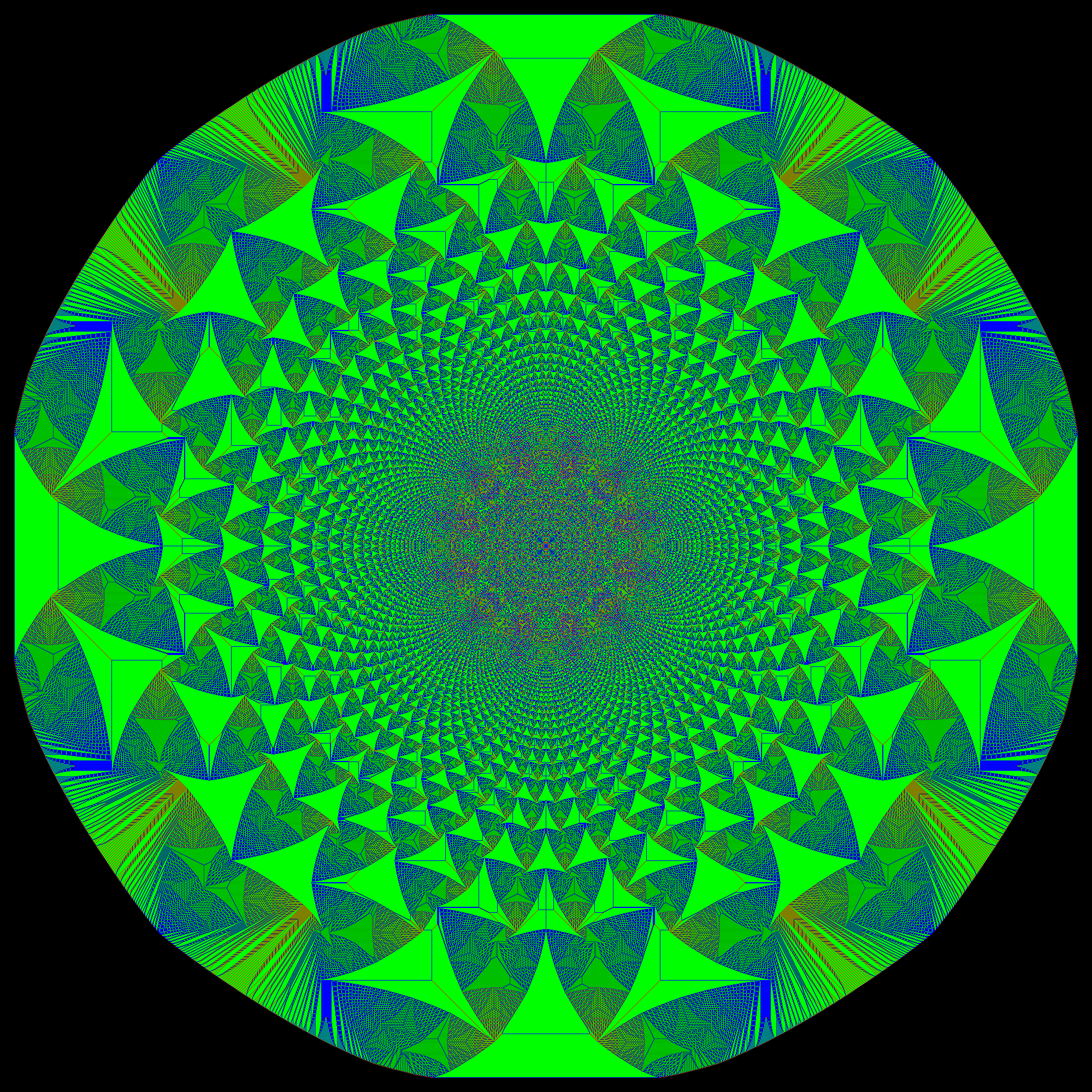
Four million grains of sand dropped onto an infinite grid. The colors represent how many grains are at each vertex. From this gallery.

We got our first snowfall of the year this past week, but my most recent mathematical find makes me think of summertime instead. The picture to the right is of a sandpile—or, more formally, an Abelian sandpile model.

If you pour a bucket of sand into a pile a little at a time, it’ll build up for a while. But if it gets too tall, an avalanche will happen and some of the sand will tumble away from the peak. You can check out an applet that models this kind of sand action here.

A mathematical sandpile formalizes this idea. First, take any graph—a small one, a medium sided one, or an infinite grid. Grains of sand will go at each vertex, but we’ll set a maximum amount that each one can contain—the number of edges that connect to the vertex. (Notice that this is four for every vertex of an infinite square grid). If too many grains end up on a given vertex, then one grain avalanches down each edge to a neighboring vertex. This might be the end of the story, but it’s possible that a chain reaction will occur—that the extra grain at a neighboring vertex might cause it to spill over, and so on. For many more technical details, you might check out this article from the AMS Notices.

This video walks through the steps of a sandpile slowly, and it shows with numbers how many grains are in each spot.

A sandpile I made with Sergei’s applet

You can make some really cool images—both still and animated—by tinkering around with sandpiles. Sergei Maslov, who works at Brookhaven National Laboratory in New York, has a great applet on his website where you can make sandpiles of your own.

David Perkinson, a professor at Reed College, maintains a whole website about sandpiles. It contains a gallery of sandpile images and a more advanced sandpile applet.

Hexplode is a game based on sandpiles.

I have a feeling that you might also enjoy playing the sandpile-inspired game Hexplode!

Next up: we’ve shared links about Fibonnaci numbers and prime numbers before—they’re some of our favorite numbers! Here’s an amazing fact that I just found out this week. Some Fibonnaci numbers are prime—like 3, 5, and 13—but no one knows if there are infinitely many Fibonnaci primes, or only finitely many.

A great place to find out more amazing and fun facts like this one is at The Prime Pages. It has a list of the largest known prime numbers, as well as information about the continuing search for bigger ones—and how you can help out! It also has a short list of open questions about prime numbers, including Goldbach’s conjecture.

Be sure to peek at the “Prime Curios” page. It contains intriguing facts about prime numbers both large and small. For instance, did you know that 773 is both the only three-digit iccanobiF prime and the largest three-digit unholey prime? I sure didn’t.

Last but not least, I ran across this article about how a software company has come up with a new solution for mixing colors on a computer screen by using six dimensions rather than the usual three.

Dimensions of colors, you ask?

The arithmetic of colors!

Well, there are actually several ways that computers store colors. Each of them encodes colors using three numbers. For instance, one method builds colors by giving one number each to the primary colors yellow, red, and blue. Another systems assigns a number to each of hue, saturation, and brightness. More on these systems here. In any of these systems, you can picture a given color as sitting within a three-dimensional color cube, based on its three numbers.

A color cube, based on the RGB (red, green, blue) system.

If you numerically average two colors in these systems, you don’t actually end up with the color that you’d get by mixing paint of those two colors. Now, both scientists and artists think about combining colors in two ways—combining colored lights and combining colored pigments, or paints. These are called additive and subtractive color models—more on that here. The breakthrough that the folks at the software company FiftyThree made was to assign six numbers to each color—that is, to use both additive and subtractive ideas at the same time. The six numbers assigned to a given number can be thought of as plotting a point in a six-dimensional space—or inside of a hyper-hyper-hypercube.

I think it’s amazing that using math in this creative way helps to solve a nagging artistic problem. To get a feel for why mixing colors using the usual three-coordinate system is such a problem, you might try your hand at this color matching game. For even more info about the math of color, there’s some interesting stuff on this webpage.

Bon appetit!

Pixel Art, Gothic Circle Patterns, and First Past the Post

Welcome to this week’s Math Munch!

Guess what? Today is Math Munch’s one-year anniversary!

We’re so grateful to everyone who has made this year so much fun: our students and readers; everyone who has spread the word about Math Munch; and especially all the people who do and make the cool mathy things that we so love to find and share.

Speaking of which…

Mathematicians have studied the popular puzzle called Sudoku in numerous ways. They’ve counted the number of solutions. They’ve investigated how few given numbers are required to force a unique solution. But Tiffany C. Inglis came at this puzzle craze from another angle—as a way to encode pixel art!

Tiffany studies computer graphics at the University of Waterloo in Ontario, Canada. She’s a PhD candidate at the Computer Graphics Lab (which seems like an amazing place to work and study—would you check out these mazes!?)

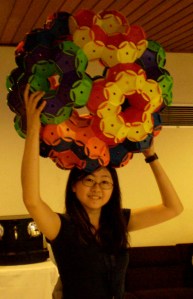
Tiffany C. Inglis, hoisting a buckyball

Tiffany tried to find shading schemes for Sudoku puzzles so that pictures would emerge—like the classic mushroom pictured above. Sudoku puzzles are a pretty restrictive structure, but Tiffany and her collaborators had some success—and even more when they loosened the rules a bit. You can read about (and see!) some of their results on this rad poster and in their paper.

Thinking about making pictures with Sudoku puzzles got Tiffany interested in pixel art more generally. “I did some research on how to create pixel art from generic images such as photographs and realized that it’s an unexplored area of research, which was very exciting!” Soon she started building computer programs—algorithms—to automatically convert smooth line art into blockier pixel art without losing the flavor of the original. You can read more about Tiffany’s pixelization research on this page of her website. You should definitely check out another incredible poster Tiffany made about this research!

To read more of my interview with Tiffany, you can click here.

Cartoon Tiffany explains what makes a good pixelization. Check out the full comic!

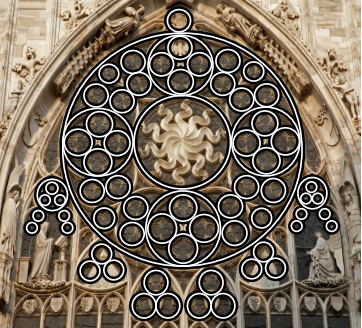
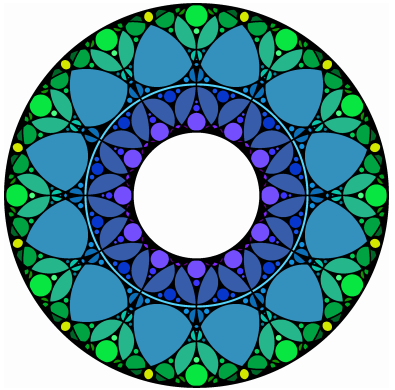
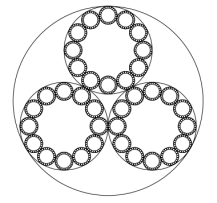
I met Tiffany this past summer at Bridges, where she both exhibited her artwork and gave an awesome talk about circle patterns in Gothic architecture. You may be familiar with Apollonian gaskets; Gothic circle patterns have a similar circle-packing feel to them, but they have some different restrictions. Circles don’t just squeeze in one at a time, but come in rings. It’s especially nice when all of the tangencies—the places where the circles touch—coincide throughout the different layers of the pattern. Tiffany worked on the problem of when this happens and discovered that only a small family has this property. Even so, the less regular circle patterns can still produce pleasing effects. She wrote about this and more in her paper on Gothic circle patterns.

I’m really inspired by how Tiffany finds new ideas in so many place, and how she pursues them and then shares them in amazing ways. I hope you’re inspired, too!

A rose window at the Milan Cathedral, with circle designs highlighted.

A mathematical model similar to the window, which Tiffany created.

An original design by Tiffany. All of these images are from her paper.

Here’s another of Tiffany’s designs. Now try making one of your own!

Using the Mathematica code that Tiffany wrote to build her diagrams, I made an applet where you can try making some circle designs of your own. Check it out! If you make one you really like—and maybe color it in—we’d love to see it! You can send it to us at MathMunchTeam@gmail.com.

(You’ll may have to download a plug-in to view the applet; it’s the same plug-in required to use the Wolfram Demonstrations Project.)

Finally, with Election Day right around the corner, how about a dose of the mathematics of voting?

I’m a fan of this series of videos about voting theory by C.G.P. Grey. Who could resist the charm of learning about the alternative vote from a wallaby, or about gerrymandering from a weasel? Below you’ll find the first video in his series, entitled “The Problems with First Past the Post Voting Explained.” Majority rule isn’t as simple of a concept as you might think, and math can help to explain why. As can jungle animals, of course.

Thanks again for being a part of our Math Munch fun this past year. Here’s to a great second course! Bon appetit!


PS I linked to a bunch of papers in this post. After all, that’s the traditional first anniversary gift!