Tag Archives: big numbers

Folds, GIMPS, and More Billiards

Welcome to this week’s Math Munch!

First up, we’ve often featured mathematical constructions made of origami. (Here are some of those posts.) Origami has a careful and peaceful feel to it—a far cry from, say, the quick reflexes often associated with video games. I mean, can you imagine an origami video game?
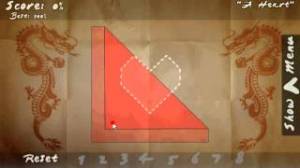
heartfolds

One of Fold’s many origami puzzles.

Well, guess what—you don’t have to, because Folds is just that! Folds is the creation of Bryce Summer, a 21-year-old game designer from California. It’s so cool. The goal of each level of its levels is simple: to take a square piece of paper and fold it into a given shape. The catch is that you’re only allowed a limited number of folds, so you have to be creative and plan ahead so that there aren’t any loose ends sticking out. As I’ve noted before, my favorite games often require a combo of visual intuition and careful thinking, and Folds certainly fits the bill. Give it a go!

Once you’re hooked, you can find out more about Bryce and how he came to make Folds in this awesome Q&A. Thanks so much, Bryce!

gimpsNext up, did you know that a new largest prime number was discovered less than a month ago? It’s very large—over 17 million digits long! (How many pages would that take to print or write out?) That makes it way larger than the previous record holder, which was “only” about 13 million digits long. Here is an article published on the GIMPS website about the new prime number and about the GIMPS project in general.

What’s GIMPS you ask? GIMPS—the Great Internet Mersenne Primes Search—is an example of what’s called “distributed computing”. Testing whether a number is prime is a simple task that any computer can do, but to check many or large numbers can take a lot of computing time. Even a supercomputer would be overwhelmed by the task all on its own, and that’s if you could even get dedicated time on it. Distributed computing is the idea that a lot of processing can be accomplished by having a lot of computers each do a small amount of work. You can even sign up to help with the project on your own computer. What other tasks might distributed computing be useful for? Searching for aliens, perhaps?

GIMPS searches only for a special kind of prime called Mersenne primes. These primes are one less than a power of two. For instance, 7 is a Mersenne prime, because it’s one less that 8, which is the third power of 2. For more on Mersenne primes, check out this video by Numberphile.

Finally, we’ve previously shared some resources about the math of billiards on Math Munch. Below you’ll find another take on bouncing paths as Michael Moschen combines the math of billiards with the art of juggling.

So lovely. For more on this theme, here’s a second video to check out.

Bon appetit!
Sandpiles, Prime Pages, and Six Dimensions of Color

Welcome to this week’s Math Munch!

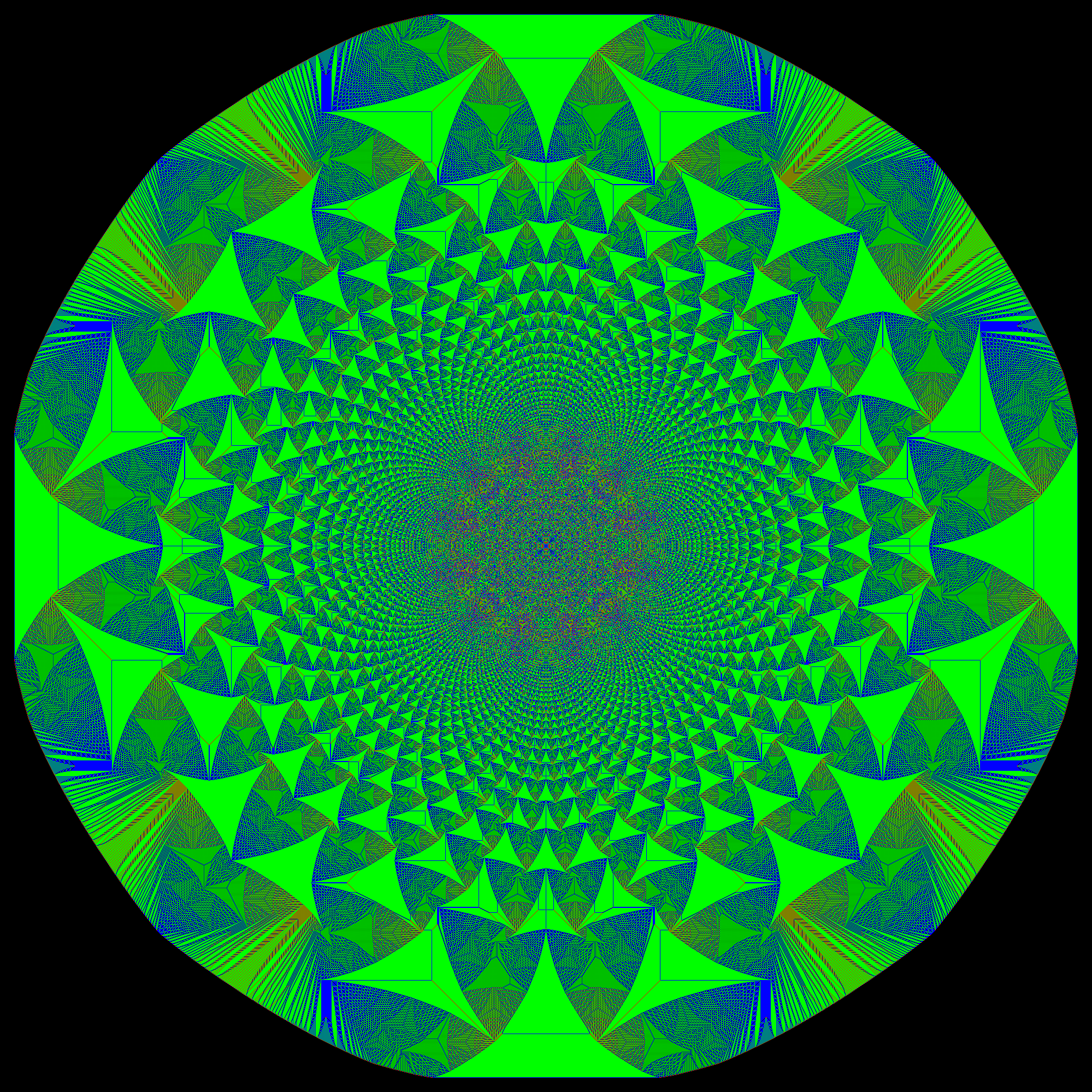
Four million grains of sand dropped onto an infinite grid. The colors represent how many grains are at each vertex. From this gallery.

We got our first snowfall of the year this past week, but my most recent mathematical find makes me think of summertime instead. The picture to the right is of a sandpile—or, more formally, an Abelian sandpile model.

If you pour a bucket of sand into a pile a little at a time, it’ll build up for a while. But if it gets too tall, an avalanche will happen and some of the sand will tumble away from the peak. You can check out an applet that models this kind of sand action here.

A mathematical sandpile formalizes this idea. First, take any graph—a small one, a medium sided one, or an infinite grid. Grains of sand will go at each vertex, but we’ll set a maximum amount that each one can contain—the number of edges that connect to the vertex. (Notice that this is four for every vertex of an infinite square grid). If too many grains end up on a given vertex, then one grain avalanches down each edge to a neighboring vertex. This might be the end of the story, but it’s possible that a chain reaction will occur—that the extra grain at a neighboring vertex might cause it to spill over, and so on. For many more technical details, you might check out this article from the AMS Notices.

This video walks through the steps of a sandpile slowly, and it shows with numbers how many grains are in each spot.

A sandpile I made with Sergei’s applet

You can make some really cool images—both still and animated—by tinkering around with sandpiles. Sergei Maslov, who works at Brookhaven National Laboratory in New York, has a great applet on his website where you can make sandpiles of your own.

David Perkinson, a professor at Reed College, maintains a whole website about sandpiles. It contains a gallery of sandpile images and a more advanced sandpile applet.

Hexplode is a game based on sandpiles.

I have a feeling that you might also enjoy playing the sandpile-inspired game Hexplode!

Next up: we’ve shared links about Fibonnaci numbers and prime numbers before—they’re some of our favorite numbers! Here’s an amazing fact that I just found out this week. Some Fibonnaci numbers are prime—like 3, 5, and 13—but no one knows if there are infinitely many Fibonnaci primes, or only finitely many.

A great place to find out more amazing and fun facts like this one is at The Prime Pages. It has a list of the largest known prime numbers, as well as information about the continuing search for bigger ones—and how you can help out! It also has a short list of open questions about prime numbers, including Goldbach’s conjecture.

Be sure to peek at the “Prime Curios” page. It contains intriguing facts about prime numbers both large and small. For instance, did you know that 773 is both the only three-digit iccanobiF prime and the largest three-digit unholey prime? I sure didn’t.

Last but not least, I ran across this article about how a software company has come up with a new solution for mixing colors on a computer screen by using six dimensions rather than the usual three.

Dimensions of colors, you ask?

The arithmetic of colors!

Well, there are actually several ways that computers store colors. Each of them encodes colors using three numbers. For instance, one method builds colors by giving one number each to the primary colors yellow, red, and blue. Another systems assigns a number to each of hue, saturation, and brightness. More on these systems here. In any of these systems, you can picture a given color as sitting within a three-dimensional color cube, based on its three numbers.

A color cube, based on the RGB (red, green, blue) system.

If you numerically average two colors in these systems, you don’t actually end up with the color that you’d get by mixing paint of those two colors. Now, both scientists and artists think about combining colors in two ways—combining colored lights and combining colored pigments, or paints. These are called additive and subtractive color models—more on that here. The breakthrough that the folks at the software company FiftyThree made was to assign six numbers to each color—that is, to use both additive and subtractive ideas at the same time. The six numbers assigned to a given number can be thought of as plotting a point in a six-dimensional space—or inside of a hyper-hyper-hypercube.

I think it’s amazing that using math in this creative way helps to solve a nagging artistic problem. To get a feel for why mixing colors using the usual three-coordinate system is such a problem, you might try your hand at this color matching game. For even more info about the math of color, there’s some interesting stuff on this webpage.

Bon appetit!

Rectangles, Explosions, and Surreals

Welcome to this week’s Math Munch!

What is 3 x 4?   3 x 4 is 12.

Well, yes. That’s true. But something that’s wonderful about mathematics is that seemingly simple objects and problems can contain immense and surprising wonders.

How many squares can you find in this diagram?

As I’ve mentioned before, the part of mathematics that works on counting problems is called combinatorics. Here are a few examples for you to chew on: How many ways can you scramble up the letters of SILENT? (LISTEN?) How many ways can you place two rooks on a chessboard so that they don’t attack each other? And how many squares can you count in a 3×4 grid?

Here’s one combinatorics problem that I ran across a while ago that results in some wonderful images. Instead of asking about squares in a 3×4 grid, a team at the Dubberly Design Office in San Francisco investigated the question: how many of ways can a 3×4 grid can be partitioned—or broken up—into rectangles? Here are a few examples:

How many different ways to do this do you think there are? Here’s the poster that they designed to show the answer that they found! You can also check out this video of their solution.

In their explanation of their project, the team states that “Design tools are becoming more computation-based; designers are working more closely with programmers; and designers are taking up programming.” Designing the layout of a magazine or website requires both structural and creative thinking. It’s useful to have an idea of what all the possible layouts are so that you can pick just the right one—and math can help you to do it!

If you’d like to try creating a few 3×4 rectangle partitions of your own, you can check out www.3x4grid.com. [Sadly, this page no longer works. See an archive of it here. -JL, 10/2016]

Next up, explosions! I could tell you about the math of the game Minesweeper (you can play it here), or about exploding dice. But the kind of explosion I want to share with you today is what’s called a “combinatorial explosion.” Sometimes a problem that appears to be an only slightly harder variation of an easy problem turns out to be way, way harder. Just how BIG and complicated even simple combinatorics problems can get is the subject of this compelling and also somewhat haunting video.

Donald Knuth

Finally, all of this counting got me thinking about big numbers. Previously we’ve linked to Math Cats, and Wendy has a page where you can learn how to say some really big numbers. But thinking about counting also made me remember an experience I had in middle school where I found out just how big numbers could be! I was in seventh grade when I read this article from the December 1995 issue of Discover Magazine. It’s called “Infinity Plus One, and Other Surreal Numbers” and was written by Polly Shulman. I remember my mind being blown by all of the talk of infinitely-spined aliens and up-arrow notation for naming numbers. Here’s an excerpt:

Mathematicians and precocious five-year-olds have long been fascinated by the endlessness of numbers, and they’ve named the endlessness infinity. Infinity isn’t a number like 1, 2, or 3; it’s hard to say what it is, exactly. It’s even harder to imagine what would happen if you tried to manipulate it using the arithmetic operations that work on numbers. For example, what if you divide it in half? What if you multiply it by 2? Is 1 plus infinity greater than, less than, or the same size as infinity plus 1? What happens if you subtract 1 from it?

After I read this article, John Conway and Donald Knuth became heros of mine. (In college, I had the amazing fortune to have breakfast with Conway one day when he was visiting to give a lecture!) Knuth has a book about surreals that’s the friendliest introduction to the surreal numbers that I know of, and in this video, Vi Hart briefly touches on surreal numbers in discussing proofs that .9 = 1. Boy, would I love to see a great video or online resource that simply and beautifully lays out the surreal numbers in all their glory!

It was fun for me to remember that Discover article. I hope that you, too, run across some mathematics that leaves a seventeen-year impression on you!

Bon appetit!